
Both processes introduce compression near the glass surface to make cracks harder to open under loading. They do it differently, and “strengthened” is not a complete specification. For a thin cover lens, the first decision is whether the material and thickness suit the process, not which method sounds stronger.
Thermal tempering uses heating and rapid cooling. Chemical strengthening uses ion exchange in a compatible glass composition. Neither removes the need to control holes, edges, handling damage and the finished assembly.
Two Ways to Introduce Surface Compression
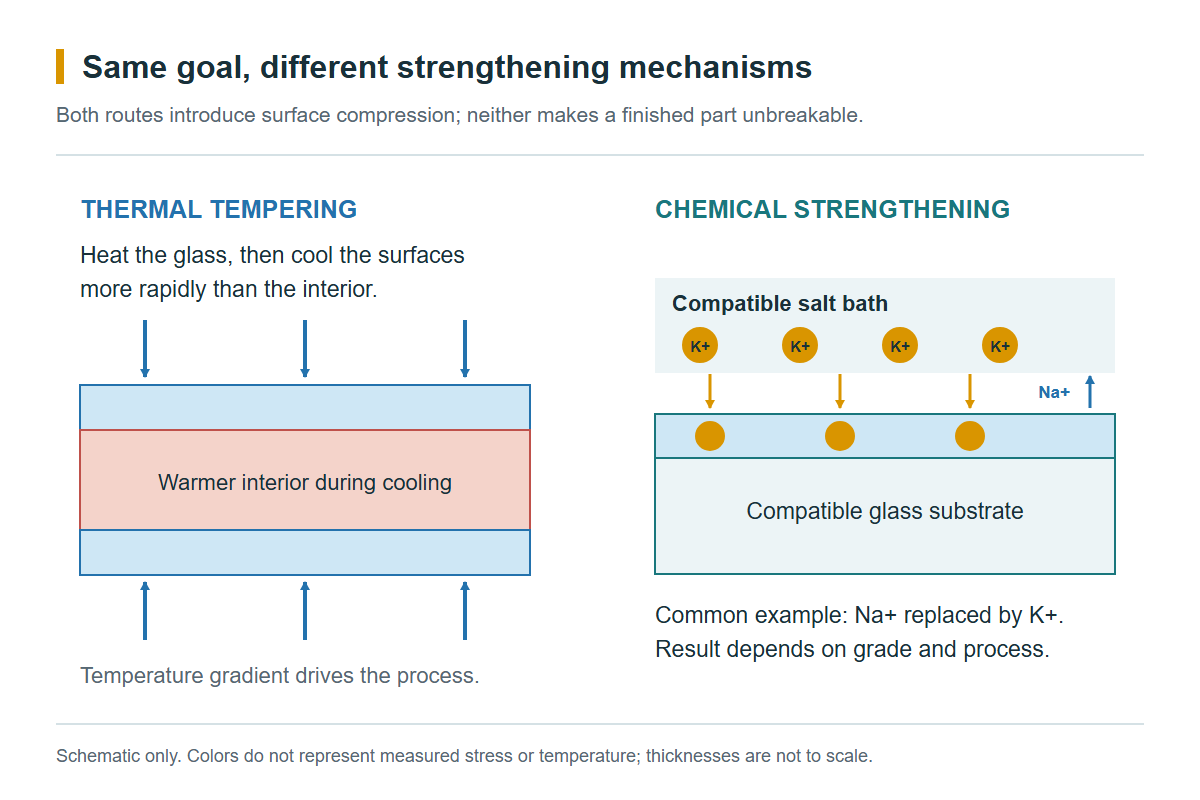
During thermal tempering, the surfaces cool more rapidly than the interior. The resulting residual stress places the outer regions in compression and the interior in tension. As glass becomes thinner, maintaining the required through-thickness temperature difference becomes more difficult. This is a central reason chemical strengthening is used for very thin covers. A single minimum thickness should not be assumed for every furnace and glass grade. Corning’s explanation of strengthening methods
In a common ion-exchange route, smaller sodium ions near the surface are replaced by larger potassium ions from a salt bath. The constrained size change creates compression. The composition and process conditions control how the stress develops; not every glass responds equally to the same bath. Corning’s ion-exchange explanation
Thickness and Grade Come Before a Strength Claim
Thermal tempering is widely used for processed soda-lime panels. Chemical strengthening is useful when a compatible thin substrate is required, particularly where thickness and optical flatness are important to the component. Neither is restricted to a single marketing label such as “display glass.”
A useful counterexample to an oversimplified rule is SCHOTT CONTURAN Tough: its published substrate options include soda-lime and low-iron soda-lime glass with a specific AR coating compatible with chemical toughening. Chemical strengthening is therefore not exclusive to aluminosilicate, and coating compatibility cannot be decided from the word “AR” alone. CONTURAN Tough product information
For a new cover, ask which named grade, thickness and finished geometry the supplier proposes. A process recommendation should describe that part, rather than comparing a thick tempered pane with a thin chemically strengthened coupon and declaring a universal winner.
Which Measurements Belong in the Specification?
Surface compressive stress describes stress, not the impact energy that a complete panel will survive. Depth of layer describes how far the measured compression extends, not the overall glass thickness. Those values help characterize chemical strengthening, but neither is an independent guarantee of drop performance.
| Design question | Useful information to request |
|---|---|
| Is the process suitable for this cover? | Named substrate, thickness and manufacturing sequence |
| Is chemical strengthening controlled? | Agreed stress/depth method, locations and acceptance limits |
| Will the fitted panel withstand impact? | Finished-part test with the actual support and contact conditions |
| Will the panel remain optically acceptable? | Flatness, distortion and viewing checks relevant to the assembly |
| What happens if it breaks? | Required safety test and retention behavior of the complete construction |
Define the acceptance basis before requesting “maximum strength.” A high compressive-stress number is not interchangeable with a validated part test, and a visually flat sample does not establish its impact resistance.
Machining, Printing and Coating Must Fit the Route
Keep the processing sequence attached to the design. In Pilkington’s published Planar specification, all edgework and holes are completed before toughening. Drilling an already thermally tempered panel is not a practical way to revise its mounting pattern. Pilkington Planar fabrication specification
Printing and coating introduce their own temperature and chemical compatibility constraints. CONTURAN Tough’s ability to be chemically toughened through its coating is an explicitly documented product feature. It should not be generalized to an unrelated AR coating or organic ink. Agree the complete route before approving an optical sample. CONTURAN Tough process chain
Strengthening Is Not the Whole Safety Design
Thermally tempered soda-lime glass is designed to produce a characteristic small-particle breakage pattern under the relevant conditions. SCHOTT describes this behavior for its processed flat-glass products. However, the word “chemically strengthened” should not be treated as an automatic equivalent safety classification. Verify the requirement that applies to the intended product. SCHOTT processed flat-glass technical details
Where retention of fragments matters, the adhesive, laminate, frame or protective assembly may be as important as strengthening. Approve the complete cover construction with its intended support. The appropriate process is the one that can repeatedly deliver that specified part, not the one with the most impressive isolated number.
See Custom Cover Glass for drawing-based covers and aluminosilicate vs soda-lime for industrial touch panels for the material decision.