
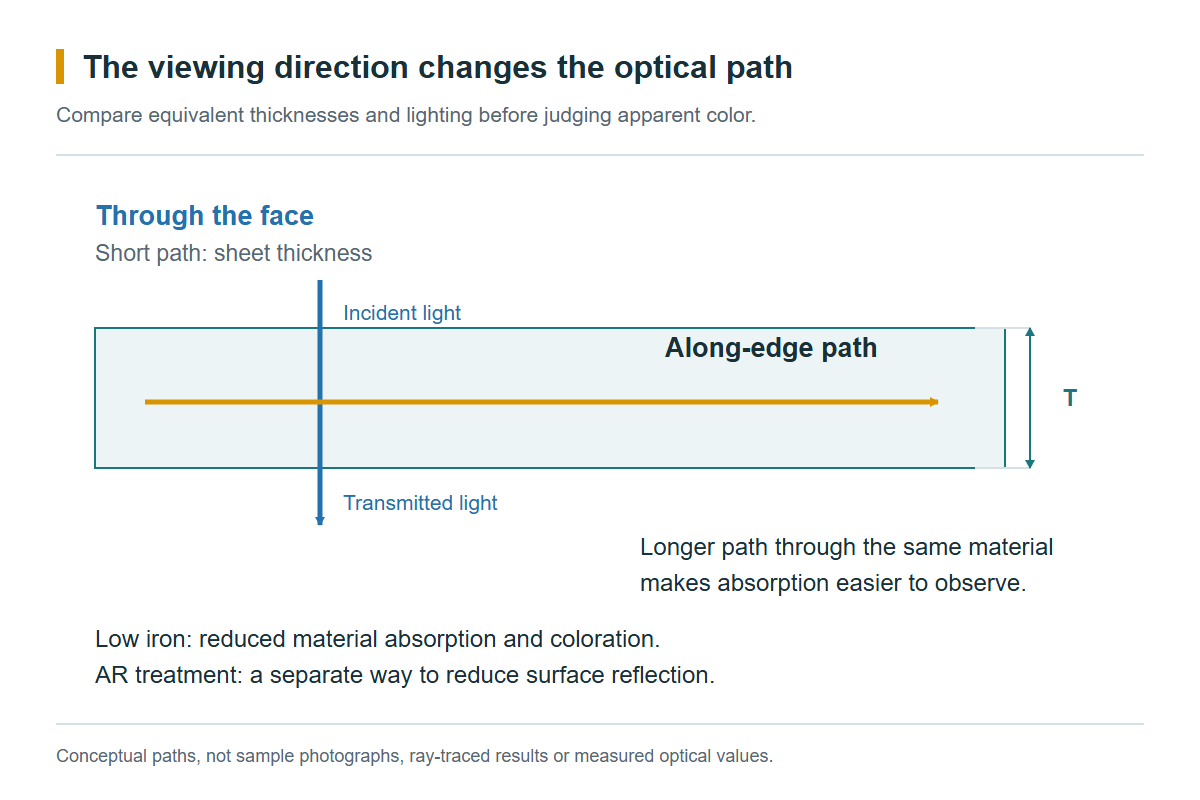
A glass sample can look clear through its face and distinctly green along its edge. That does not mean the edge has a coating. Light travelling along the sheet passes through much more material than light travelling through its thickness, making absorption and color easier to see.
Low-iron glass reduces this coloration and the associated absorption. It is useful when transmitted light, a neutral appearance or the color of a printed background matters. It is not automatically anti-reflective, heat-resistant or stronger than ordinary clear glass.
Start with the Light Path, Not the Product Name
Low-iron float glass is a soda-lime glass with reduced iron content. Pilkington describes its Optiwhite grade as having less green coloration than conventional clear float glass of comparable thickness. The important comparison is between equivalent samples, not between a thin clear pane and a much thicker low-iron block. Pilkington glass terminology
Through-thickness and along-edge viewing reveal different optical paths. A short path may show little visible color difference; a long path makes material absorption more noticeable. This is why edge appearance can matter on a polished component even when the face looks acceptable.
Less Absorption Is Not the Same as Less Reflection
Reflection occurs at an interface; absorption occurs within the material. Reducing iron primarily addresses the second mechanism. An untreated low-iron surface still reflects light.
Pilkington’s fabrication bulletin explicitly distinguishes these effects: its low-iron glass has lower absorption but approximately the same reflection as standard clear glass, about 4% at each surface in the stated comparison. That approximate value is not a guaranteed reflection specification for every wavelength or angle. Pilkington ATS-160
If the problem is a reflected ceiling lamp obscuring a display, changing the substrate alone may not solve it. An appropriate AR treatment addresses reflected intensity; AG texture changes the distribution of a reflection. Material selection and surface treatment therefore need separate decisions. See why AG and AR are sometimes used together.
Compare Transmission on the Same Basis
A transmission percentage is meaningful only with the sample and measurement conditions. Visible-light transmission, solar transmission and transmission at a particular wavelength are not interchangeable numbers.
For one useful reference, Pilkington’s Optiwhite summary lists 92% light transmission at 4 mm and 90% at 19 mm, determined under its stated EN 410 basis. These are published values for a named supplier grade, not universal acceptance values for all low-iron glass. The same summary separates light transmission from solar properties. Optiwhite performance summary
For a camera window, compare the wavelength band the camera uses. For a display, compare color and viewing performance in the finished stack. For solar glazing, use the relevant solar measurement basis. A bare-sheet number does not include losses from a coating, adhesive, sensor or second pane added later.
Where Does Low-Iron Material Earn Its Cost?
| Requirement | Why low-iron may help | What still needs checking |
|---|---|---|
| White or light-colored printed panels | Less substrate coloration affecting the viewed background | Ink, print side, opacity and actual sample color |
| Exposed polished edges | More neutral appearance over a long optical path | Thickness, edge finish and lighting |
| High-transmission glazing | Reduced absorption in the material | Measurement band, surface treatment and completed construction |
| Display or sensor windows | More neutral transmitted light where relevant | Reflection, optical distortion and system performance |
These are selection reasons, not evidence that every application requires an upgrade. A concealed, black-printed equipment panel may gain little from an optical improvement that the user never sees. A thick transparent component or a panel with a white background may justify a sample comparison much earlier.
What the Upgrade Does Not Specify
“Low-iron” does not define the outline tolerance, edge quality, strengthening state or safety behavior. Put those requirements on the drawing or purchase specification separately. Do not replace a borosilicate requirement with low-iron soda-lime simply because both appear transparent.
Manufacturing also needs the exact grade. Pilkington notes that its low-iron product’s absorption and thermal characteristics affect tempering furnace settings compared with standard clear glass. That is a grade-specific processing consideration, not a recipe to copy into another furnace. ATS-160 fabrication guidance
For a first evaluation, specify the thickness, viewed area, wavelength or transmission method, strengthening and print or coating configuration. Compare finished samples under the intended lighting. That test answers a more useful question than “Which glass is clearer?”: whether the material change improves the part’s actual job.
For material options, visit Low Iron Glass.