
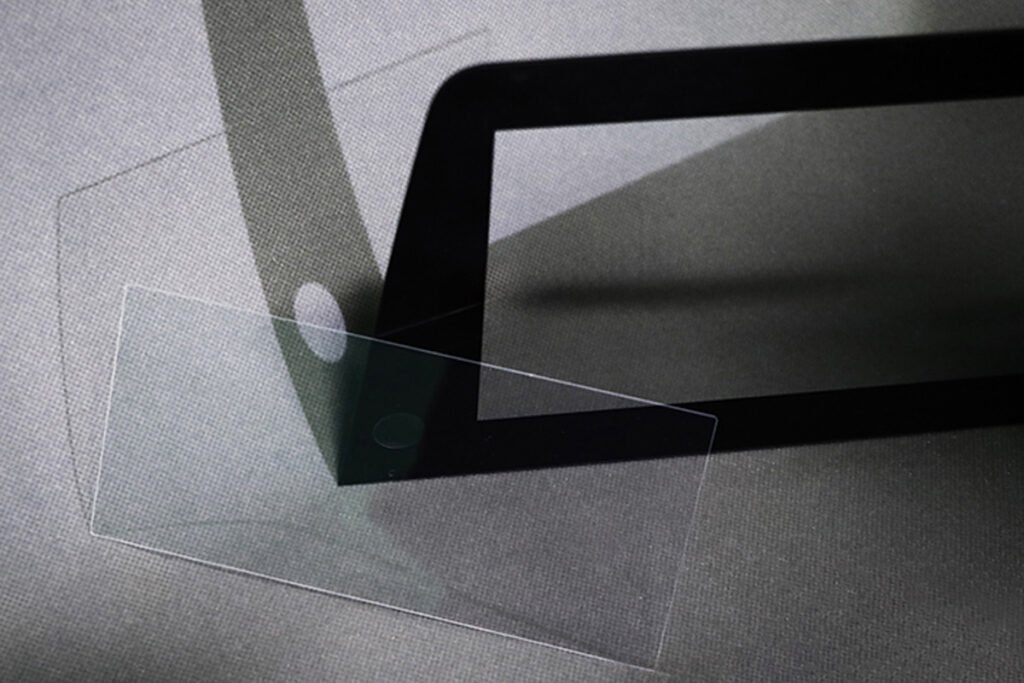
Medium-Alumina Ultra-Clear Glass
Our existing medium-grade substrate covers 0.25-2.0 mm. It supports thin cover components with defined geometry, printing and an agreed ion-exchange profile.
Aluminosilicate glass includes multiple compositions, not one universal high-strength material. Alkali-containing cover grades support ion exchange, while the achievable stress profile depends on the composition and strengthening cycle.
Our medium-alumina range provides ultra-clear thin sheet for display and equipment covers. High-alumina options are specified separately when a different chemical-strengthening response is required. Both can be supplied as base sheet or processed components.
| Parameter | Supply Range | Available Options |
|---|---|---|
| Material grades | Medium-alumina cover substrate | Separately specified high-alumina grades |
| Medium-grade thickness | 0.25-2.0 mm | Selected thin-sheet gauges within the range |
| Sheet format | 1300 x 1100 mm medium grade | Finished cut size and other grade formats |
| Supply condition | Unstrengthened sheet or processed part | Chemically strengthened finished covers |
| Component processing | CNC, holes, edge finishing and printing | Compatible functional coatings |
| Strengthening specification | Grade-specific CS and DOL | Inspection against the agreed material/process condition |
Our existing medium-grade substrate covers 0.25-2.0 mm. It supports thin cover components with defined geometry, printing and an agreed ion-exchange profile.
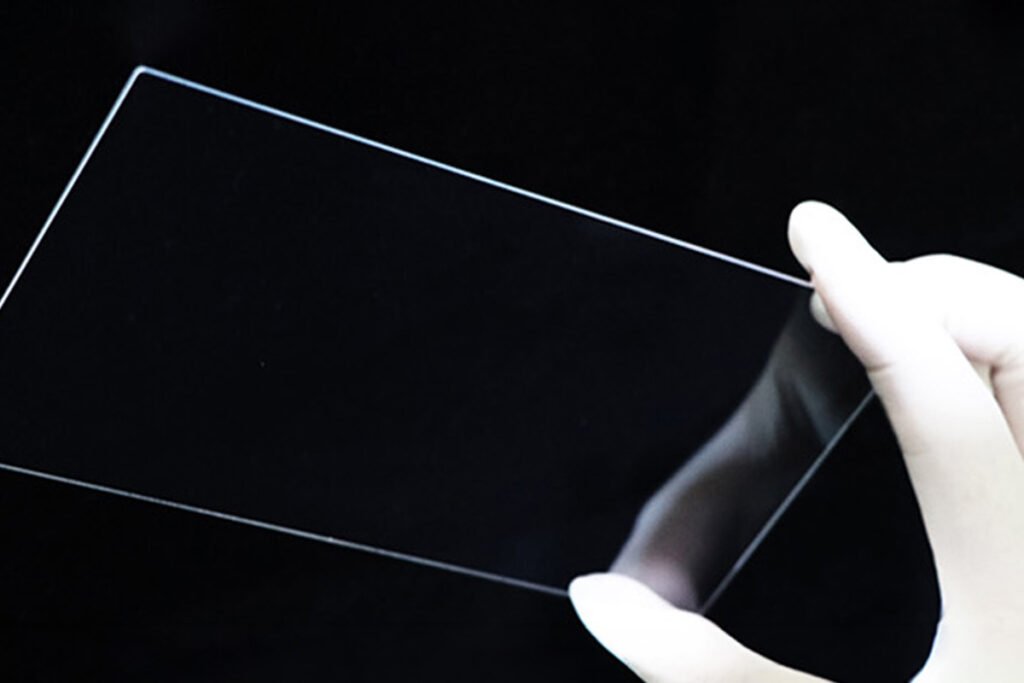
High-alumina sheet is selected as a separate material grade. Thickness availability and strengthening response are specified by grade rather than copied from the medium-alumina data.
| Property | Medium-Grade Reference |
|---|---|
| Density | 2.48 +/-0.01 g/cm3 |
| Refractive index | 1.51 +/-0.01 |
| Thermal expansion | (8.5 +/-0.5) x 10^-6/K |
| Al2O3 content | 4.5-8.0% |
| Characteristic | Existing Medium-Grade Specification |
|---|---|
| Surface compressive stress | CS >=650 MPa |
| Depth of layer | DOL >=10 micrometres |
| Sample thicknesses | 0.55 / 0.80 / 1.10 / 1.30 mm |
| Process reference | 420 C / 3.5 hours |
These values retain the existing medium-grade specification. The strengthening figures apply to the listed sample thicknesses and process reference, not every grade, thickness or finished geometry. Final-part acceptance follows the agreed inspection plan.
During ion exchange, larger potassium ions replace smaller sodium ions near the surface of a suitable glass grade. The constrained surface layer develops compression while the glass core balances the stress.
CS describes surface compressive stress; DOL describes the depth of the exchanged layer. Neither value alone is a universal bending-strength, drop-height or scratch-proof rating. Edge damage, scratches, thickness and mounting affect the behavior of a finished cover. The two measurements are therefore considered together with geometry and condition.
Profiles, mounting holes, slots and radiused corners are completed within the qualified processing sequence. Edge quality is important before strengthening.
Opaque bezels, symbols, translucent backlit areas and transparent viewing windows are aligned to the component drawing and artwork.
Compatible AG, AR or AF configurations can be specified with defined active areas and face orientation. Treatment order follows the qualified substrate/coating system.
Printing and coating position varies with the ink, coating chemistry and thermal requirements; it is not one fixed process order for every configuration.
| Application | Glass Configuration | Controlled Features |
|---|---|---|
| Touch & display covers | Thin sheet with processed outline and printed bezel | Optical window, edge condition and surface treatment |
| Industrial HMI | Strengthened interface component | Mounting geometry, cosmetic zones and cleaning exposure |
| Automotive display covers | Specified cover grade and processed geometry | Printed areas and assembly validation |
| Transparent functional substrates | Clean thin sheet or finished substrate | Coating compatibility and defined surface quality |
Material, processing and finished-component details.
No. Their compositions and ion-exchange responses differ. Material properties and strengthening targets are stated for the selected grade.
The existing medium-grade range is 0.25-2.0 mm, with a 1300 x 1100 mm sheet format. Finished parts are processed to the component drawing.
No. CS is surface compressive stress, not a universal finished-part bending strength. Bending and impact behavior also depend on edge condition, damage, geometry and the test setup.
No. DOL depends on material composition and the ion-exchange condition. The listed medium-grade reference applies to specified sample thicknesses and process conditions.
Yes. Finished covers can combine printing and compatible functional treatments. Process order is qualified for the selected ink, coating system and substrate.
No. Strengthening improves damage tolerance but does not make glass immune to surface damage. Finished-part performance is evaluated under the agreed conditions.
Include: material grade, thickness, drawing, printing or coating, strengthening targets, inspection requirements and quantity.
We review sheet selection and finishing against the specified CS/DOL profile and finished component design.
Tell us the material, size, thickness, tolerance, quantity, application, and any holes, slots, edges, coating, printing, or polishing requirements. We can manufacture custom glass components from your drawing, CAD file, sketch, or sample.