
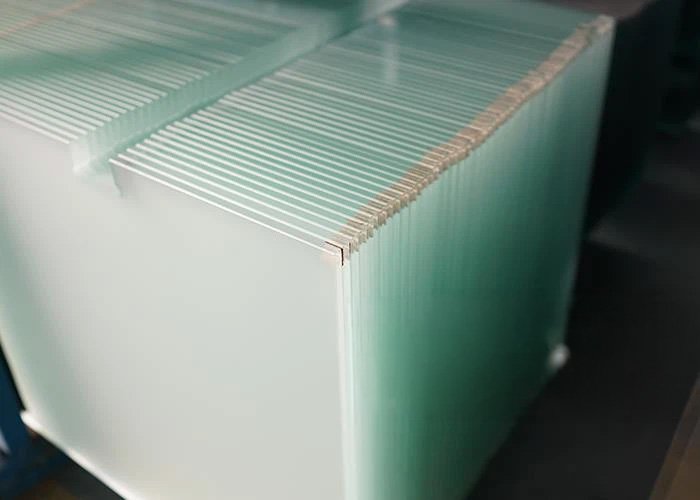
High Direct Light
Ultra-Clear Float Greenhouse Glass
Smooth low-iron glass for zones where maximum direct transmission is more important than strong diffusion.
Greenhouse solar glass is selected by both transmission and diffusion. Low-iron composition reduces absorption, a textured surface controls haze, and AR treatment reduces reflection at the air/glass boundary.
The useful choice depends on crop canopy, greenhouse geometry, climate and whether the panel is installed on the roof or sidewall.
| Base glass | Ultra-clear low-iron float or patterned glass |
|---|---|
| Thickness | 3.2 / 4 / 5 / 6 mm |
| Maximum size reference | Up to 1300 x 2500 mm, subject to configuration |
| Iron content reference | ≤150 ppm Fe2O3 |
| Direct transmission | Up to 97.5% on selected double-AR references |
| Haze options | 5-75% in defined low, medium and high diffusion grades |
| Surface | Float / single-frost / double-frost / pear-grain / cloth-grain |
| AR configuration | Uncoated / single-side / double-side |
| AR film reference | Approx. 90-120 nm for selected configurations |
| Heat treatment | Annealed or physically tempered |
| Processing | Cutting, seaming, grinding, holes and IGU fabrication |
| Surface option | Hydrophilic behavior available by configuration |
Unless stated otherwise, numerical values are typical industry references. Final capability and acceptance limits are confirmed against the ordered construction, test method and approved specification.
Each type uses a different balance of direct light, diffuse light and surface reflection.
Smooth low-iron glass for zones where maximum direct transmission is more important than strong diffusion.
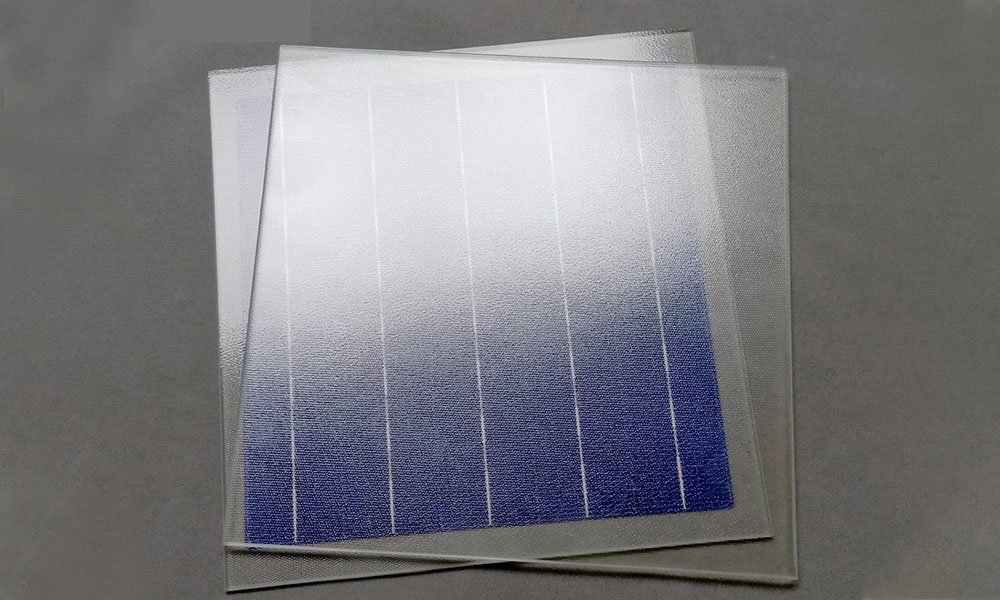
One textured face introduces selectable diffusion while the opposite face remains clearer.
Two textured faces distribute transmitted light more broadly through dense crop canopies.
A rolled pear-grain surface changes angular light distribution for roof glazing.
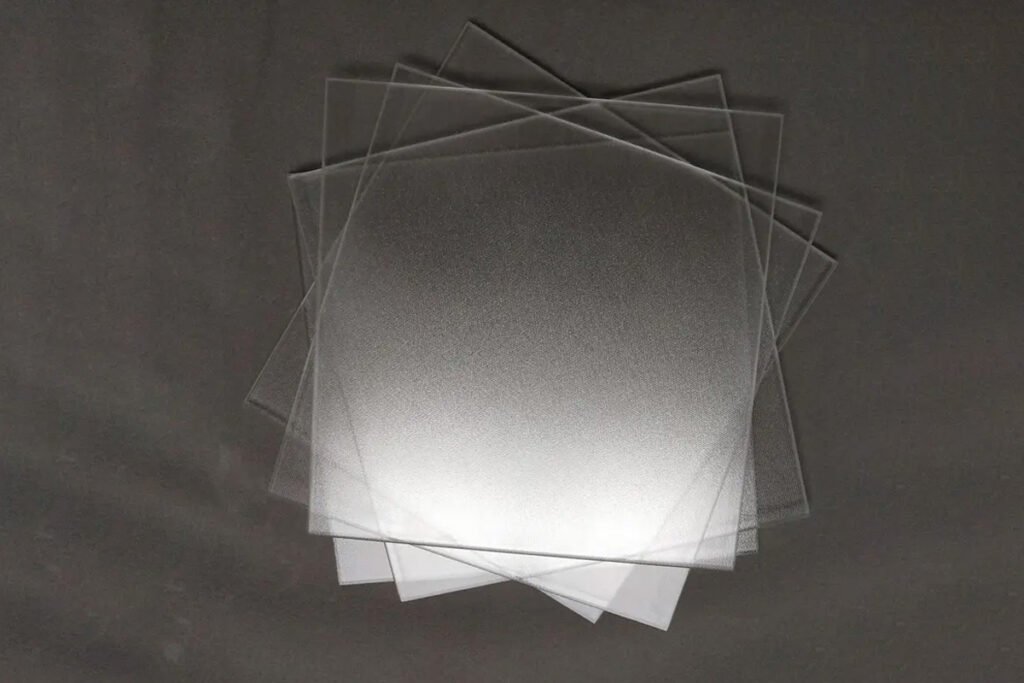
A finer pattern for projects requiring a controlled optical texture and diffuse appearance.
Use this as an early selection guide. Crop-specific light modeling and approved glass samples should set the final haze.
A larger direct-light component can suit propagation zones, sidewalls and structures where canopy penetration is less demanding.
Medium haze balances direct and scattered light for common vegetable and flower greenhouse layouts.
High diffusion spreads light more broadly and can improve distribution through tall, dense crops.
Direct transmission tracks the original light path; hemispherical transmission also accounts for light redistributed to other angles. The following supplied values are reference data, not SpecialGlass production measurements.
| Glass Grade | Direct 4 mm | Direct 5 mm | Hemispherical 4 mm | Hemispherical 5 mm |
|---|---|---|---|---|
| Single-Frost | 91.6% | 90.7% | 82.1% | 81.3% |
| Single-Frost + 1AR | 94.3% | 93.5% | 86.1% | 85.5% |
| Single-Frost + 2AR | 97.3% | 96.4% | 88.3% | 87.5% |
| Double-Frost | 91.7% | 91.0% | 82.3% | 81.5% |
| Double-Frost + 1AR | 94.5% | 94.0% | 86.4% | 85.7% |
| Double-Frost + 2AR | 97.5% | 96.8% | 88.7% | 87.7% |
| Pear-Grain | 91.4% | 90.7% | 79.8% | 78.9% |
| Pear-Grain + 2AR | 97.1% | 96.3% | 86.5% | 85.7% |
| Ultra-Clear Float | 91.5% | 90.8% | 82.5% | 81.6% |
| Ultra-Clear Float + 2AR | 97.5% | 96.7% | 88.6% | 87.4% |
Use the approved glass grade, coating state, thickness and measurement method when setting acceptance criteria.
Reflection and condensation are separate surface problems. The specified surface package can address both where the ordered coating system supports it.
A hydrophilic surface encourages condensation to spread as a film instead of isolated droplets, helping maintain more consistent optical behavior.
Confirm hydrophilic performance and durability for the ordered coating system.AR treatment reduces air/glass reflection. Selected 4 mm references progress from roughly 91% uncoated to about 94% with one AR face and up to about 97.5% with two.
Coating thickness, adhesion and hardness are confirmed by configuration.The surface pattern determines haze and how transmitted light spreads through the greenhouse.
Approve haze and surface sample independently of AR performance.Reduced iron content limits absorption inside the glass before surface pattern and coatings influence the remaining light.
State thickness and iron-grade reference when comparing transmission.Clear glass keeps more light on its original path. Diffuse glass scatters part of the transmitted light over a wider range of angles, helping distribute it through a crop canopy. AR treatment adds another variable by reducing reflection. The greenhouse specification should therefore combine low-iron glass, selected haze, surface pattern, AR configuration and tempering.
Glass forming, surface treatment and final fabrication are released against the agreed horticultural and installation specification.
Choose low-iron float or a defined diffuse pattern.
Use single- or double-side AR and compatible hydrophilic behavior as specified.
Cut roof or sidewall sizes, grind edges and drill before heat treatment.
Apply the agreed safety process or insulated construction.
Verify haze, transmission, coating, dimensions and surface quality.
Inspection limits and reporting level follow the drawing, purchase specification and approved sample.
Roof, sidewall and crop areas do not always need the same haze or coating configuration.
| Application | Suggested Starting Point | Primary Goal |
|---|---|---|
| Vegetable greenhouse | Medium-high haze + one- or two-side AR | Canopy light distribution |
| Flower greenhouse | Medium haze + AR | Uniform crop-area illumination |
| Propagation / seedlings | Low haze, high transmission | Stronger direct-light component |
| High-wire crops | High haze + double-side AR | Deep canopy distribution |
| Roof glazing | Tempered low-iron diffuse glass | Optics plus exposed safety |
| Sidewalls | Ultra-clear float or low haze | Clearer lateral transmission |
Optical data should always identify thickness, surface, coating faces and measurement method.
It is low-iron horticultural glazing designed to transmit high levels of sunlight while providing a selected level of light diffusion.
Direct transmission follows the original light direction. Hemispherical transmission includes light scattered to other angles after passing through the glass.
Defined grades can cover approximately 5-75% haze, including low, medium and high-diffusion options.
Low haze retains more direct light; medium haze balances direct and diffuse light; high haze is considered for dense or high-wire crop canopies.
Yes, on compatible products. Single-side and double-side AR configurations are available, with final performance confirmed for the selected glass type.
Selected 4 mm reference configurations reach approximately 97.5% direct transmission. This is typical reference data and must be confirmed for the ordered glass and method.
Yes. Cutting, edge work and holes are completed first, followed by physical tempering and inspection to the agreed standard.
Yes. Double- or project-specific multi-pane greenhouse glazing can be reviewed around thermal and framing requirements.
Typical checks include direct and hemispherical transmission, haze, coating uniformity, dimensions, holes, edges, flatness, surface defects and tempering quality.
For greenhouse glass, include the crop, greenhouse zone and optical targets so haze and AR are not selected in isolation.
Share the application, drawing, performance target and quantity. We will review the glass construction and processing route before quotation.
Tell us the material, size, thickness, tolerance, quantity, application, and any holes, slots, edges, coating, printing, or polishing requirements. We can manufacture custom glass components from your drawing, CAD file, sketch, or sample.