
Cut-to-Size Float Sheets
Flat panels with cut, seamed, ground or polished edges for further processing or direct integration.
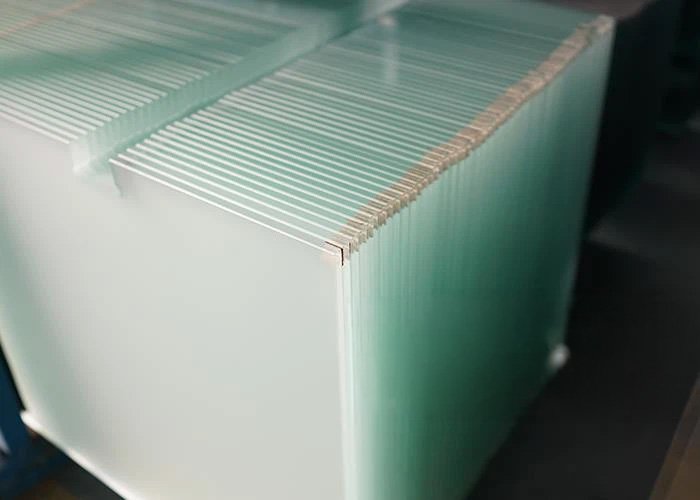
Low-iron glass is soda-lime glass made with reduced iron content. Lower absorption reduces the green coloration seen in conventional clear float, particularly along exposed edges or through thicker sections.
Its value is most visible in white printed backgrounds, illuminated panels and transparent covers where color fidelity matters. The base glass remains compatible with established cutting, machining, thermal processing, printing and lamination routes.
| Parameter | Supply Range | Available Options |
|---|---|---|
| Base material | Low-iron soda-lime float | Smooth ultra-clear sheet substrate |
| Thickness | Thin cover grades and standard float sheets | 0.1-6 mm cover configurations; thicker sheet grades by product |
| Iron specification | Low-iron grade | Selected solar grades at or below 150 ppm Fe2O3 |
| Visible transmission | Typically above 91% for common thin uncoated grades | Thickness- and grade-specific optical specification |
| Supply condition | Cut sheet or finished component | Annealed, strengthened or laminated |
| Additional processing | CNC, edge finishing and printing | AR, AG or AF configurations on compatible substrates |
Iron limits and transmission refer to the selected grade. Visible transmission is not interchangeable with solar-weighted transmission.

Flat panels with cut, seamed, ground or polished edges for further processing or direct integration.
Bezel printing, symbols, translucent areas and processed mounting features combined with the specified strengthening route.
Functional surface configurations and laminated constructions that retain the neutral-color base substrate.
| Characteristic | Low Iron Glass | Standard Clear Glass |
|---|---|---|
| Through-glass appearance | Reduced green tint | More noticeable green tint as the optical path increases |
| Exposed edges | More neutral edge appearance | Green edge appearance is often more visible |
| White printing & backlighting | Better preservation of neutral white tones | Substrate tint may influence the visible color |
| Machining & treatment | Compatible float-glass processing routes | Compatible float-glass processing routes |
| Material choice | Color-critical and high-transmission components | General-purpose, cost-sensitive components |
Light traveling through a longer glass path experiences more absorption. Looking through the face of a thin sheet and looking along its edge therefore produce different visual results, even when the glass composition is the same.
Reducing iron lowers the absorption responsible for the familiar green bias, but does not make every thickness perfectly colorless. Material grade, thickness, lighting and the background all affect appearance. A finished-size sample gives a more useful appearance reference than a small chip viewed under unrelated lighting.
A neutral optical path for displays, backlit interfaces and transparent covers. Combine with the required bezel printing and surface treatment.
Improved white and light-color appearance in printed panels, legends and control windows.
Clear windows and laminated parts where the substrate color remains visible through the final assembly.
Low-iron float is one solar-glass option. Patterned rolled glass, AR-treated PV front glass and horticultural glazing have additional surface and optical requirements. Their product pages cover those finished configurations.
View Low-Iron Solar GlassMaterial, processing and finished-component details.
Low-iron float belongs to the soda-lime material family. Its composition contains less iron to reduce absorption and visible green tint.
Reduced iron content does not itself create a strengthened glass. Mechanical behavior depends on thickness, edge condition, treatment and the finished design.
Yes. Suitable thicknesses and configurations support thermal processing, ceramic printing and other downstream treatments. Thin cover substrates may use a different strengthening route.
No. Transmission changes with thickness, material grade, surface condition, coating and the measurement basis. A visible-light figure should not be substituted for a solar-weighted value.
Not automatically. Smooth float and rolled patterned glass have different surface optics. The PV or greenhouse construction determines which substrate and coating configuration is appropriate.
Include: thickness, drawing or cut size, visible appearance, optical requirement, strengthening, printing or coating, and quantity.
We match the low-iron substrate and downstream processing to the required finished part.
Tell us the material, size, thickness, tolerance, quantity, application, and any holes, slots, edges, coating, printing, or polishing requirements. We can manufacture custom glass components from your drawing, CAD file, sketch, or sample.