
Optical Windows & Blanks
Flat windows and substrate blanks with defined optical faces, clear apertures and edge treatment. Round and rectangular forms can be processed to the housing geometry.
Optical glass is selected for a specific optical function rather than transparency alone. Refractive index and dispersion matter in refracting components; wavelength transmission, homogeneity and surface quality matter in windows and filters.
SpecialGlass supplies drawing-based parts using nominated optical grades, fused silica, selected borosilicate and filter substrates. Cut blanks, machined parts and coated configurations are kept distinct so the supplied condition matches the component drawing.
| Parameter | Supply Range | Available Options |
|---|---|---|
| Substrate | Named optical crown and filter grades | Fused silica, borosilicate and specified equivalent grades |
| Supply form | Sheets, blanks, discs and flat windows | Profiles and reflective/filter components |
| Thickness | To grade and component drawing | Thin substrates or thicker machined blanks |
| Optical band | Visible, UV or IR requirement | Band-specific substrate and coating selection |
| Optical faces | Defined clear aperture and face orientation | Flatness, parallelism and surface quality to specification |
| Coating | Uncoated or specified optical coating | AR, reflective and wavelength-selective configurations |
Transmission and optical tolerances are stated for the named grade and finished configuration, not as one value for all optical glass.
Flat windows and substrate blanks with defined optical faces, clear apertures and edge treatment. Round and rectangular forms can be processed to the housing geometry.
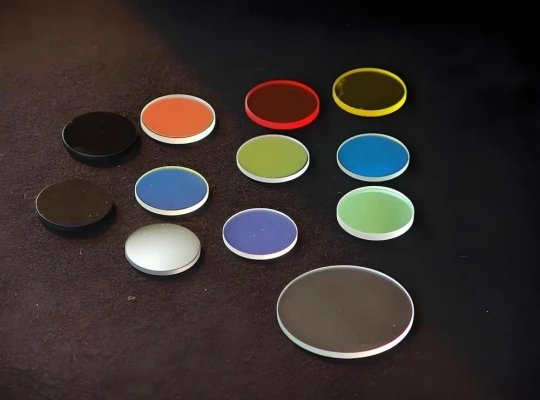
Absorptive filter substrates or coated configurations selected for a specified transmission band. Color appearance alone does not define the filter response.
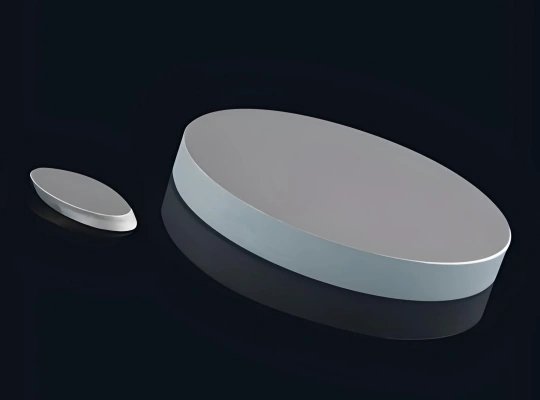
Glass substrates for reflective optical surfaces. Substrate shape, coated face and usable aperture are identified separately.

Drawing-based shaped substrates with specified optical and non-optical faces. Face angles and optical finishing are reviewed as part of the component specification.
Optical crown grades are specified when material homogeneity, index or dispersion is part of the design. Low-iron or borosilicate substrates may be suitable for protective windows with less demanding transmitted-wavefront requirements.
Controlled characteristics: grade, aperture, thickness, parallelism and surface condition.
UV windows require a fused-silica grade suited to the operating band. Purity, absorption, OH content and coating choice can affect the result. Ordinary clear or low-iron float is not treated as a universal UV substitute.
Controlled characteristics: grade, transmission band, cleanliness and optical faces.
Absorptive glass controls transmission within the material; a thin-film coating controls wavelength response at a surface. Reflective parts use a different coated configuration. The component specification defines the required optical function.
Controlled characteristics: pass/stop band, incidence angle, coated face and aperture.
The outside profile locates the part in its holder. The clear aperture is the area that must remain usable by the optical path. A retaining ring, printed mask, chamfer or coating exclusion can reduce that area without changing the overall part size.
The drawing identifies the optical face, aperture boundary and coating side. Where transmitted-wavefront quality matters, face flatness and parallelism are specified separately from edge and outline dimensions. This prevents a mechanically correct window from becoming an optical obstruction.
| Production Stage | Manufacturing Scope | Inspection Characteristic |
|---|---|---|
| Geometry | Cutting, CNC profiling, drilling and edge finishing | Profile, thickness, holes and chamfers |
| Optical faces | Specified optical finish or supplied sheet surface | Surface quality, flatness and parallelism where specified |
| Functional surface | Optical coating and defined face orientation | Band-specific transmission or reflection where specified |
| Final condition | Cleaning and protected packing | Aperture cleanliness, scratches and visible defects |
Material, processing and finished-component details.
Optical glass is supplied as a named grade with controlled optical properties. Clear float glass is a practical transparent substrate, but it is not automatically equivalent in homogeneity, dispersion or optical surface quality.
Yes. The substrate grade and supplied condition are specified with the drawing, optical aperture and required finishing. Equivalent grades are reviewed against the relevant material properties rather than appearance alone.
No. Transmission depends on the silica grade, wavelength, thickness and absorption characteristics. The operating band is required for grade selection.
Coated configurations are available. The coating specification identifies the wavelength band, incidence conditions, coated face and clear aperture.
Mechanical dimensions and optical properties are listed separately. Where needed, the drawing includes flatness, parallelism, surface quality and transmitted-wavefront requirements with the applicable measurement basis.
Include: material grade or optical function, wavelength band, drawing, clear aperture, coating side, surface-quality requirement and quantity.
We review the substrate, machining and coating route against the finished optical specification.
Tell us the material, size, thickness, tolerance, quantity, application, and any holes, slots, edges, coating, printing, or polishing requirements. We can manufacture custom glass components from your drawing, CAD file, sketch, or sample.