
Start With Synthetic Fused Silica
Synthetic grades are commonly reviewed for deep-UV transmission and tightly controlled impurity behavior.
- Minimum wavelength
- Transmission at the actual thickness
- OH grade, fluorescence and inclusion limits
Quartz glass is used as a broad commercial term, but natural fused quartz and synthetic fused silica can have different impurity, hydroxyl, inclusion and spectral characteristics. Those differences matter for UVC systems, semiconductor service, IR optics and high-temperature observation.
The drawing defines the plate, disc, sleeve, window or machined part. The application defines the grade. We review wavelength, temperature, atmosphere, purity, surface quality and geometry before selecting cutting, grinding, drilling and polishing operations.
| Material route | Natural fused quartz or synthetic fused silica by application |
|---|---|
| Reference CTE | About 0.5 x 10^-6/K near room temperature for common fused silica |
| Spectral band | UVC, UV, visible, NIR or grade-specific IR requirement |
| Purity controls | Metallic impurities, OH content and contamination limits where required |
| Optical controls | Transmission, homogeneity, birefringence, inclusions and surface quality |
| Thermal duty | Continuous, peak, gradient, cycle and atmosphere stated separately |
| Approval | Named grade, certificate, inspection method and approved sample |
Reference framework for quotation. Controlled values and test methods are stated in the approved specification.
Choose the dominant requirement before assigning a commercial quartz grade.
Synthetic grades are commonly reviewed for deep-UV transmission and tightly controlled impurity behavior.
Both routes may be viable. Select by homogeneity, OH, inclusions, size, temperature and cost rather than purity alone.
Very low CTE is useful, but mounting stress, devitrification and contamination at temperature must be controlled.
Control metallic contamination, OH, bubbles/inclusions, cleaning and packing for the actual process.
OH absorption and grade composition can change the usable IR band. Request a thickness-specific curve.
The same shape can require a different grade when wavelength or contamination changes.

Grade-controlled windows and plates for UV sources, sensors and disinfection equipment.
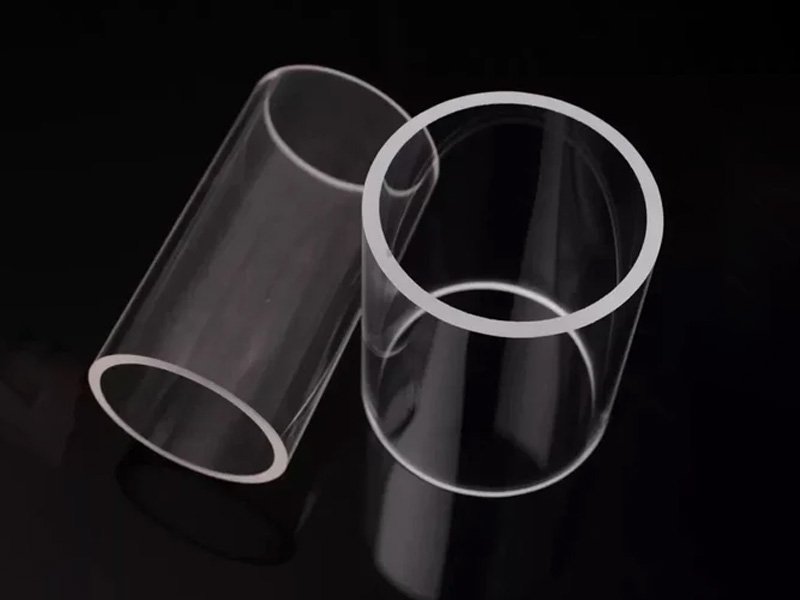
Low-expansion viewing parts for furnaces and thermal processes, with mounting review.
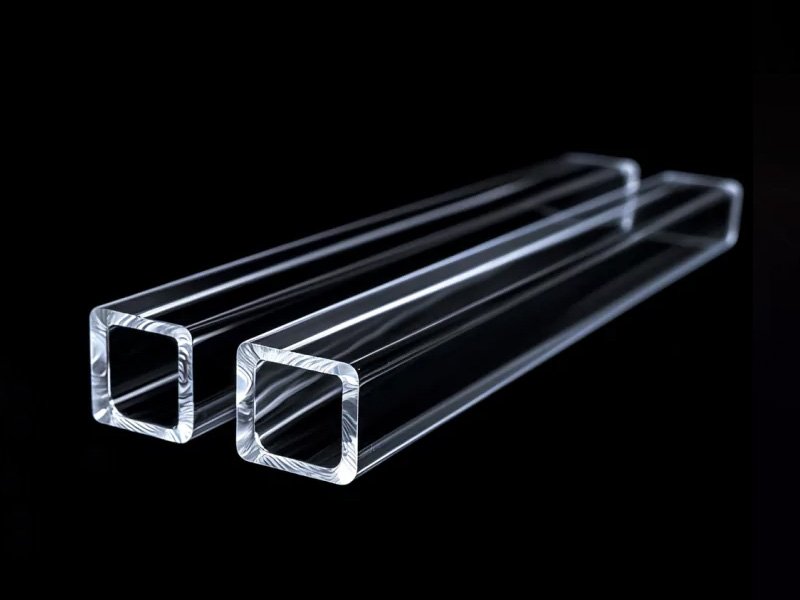
OD, ID, wall, length, straightness, end finish and wavelength matched to the lamp system.
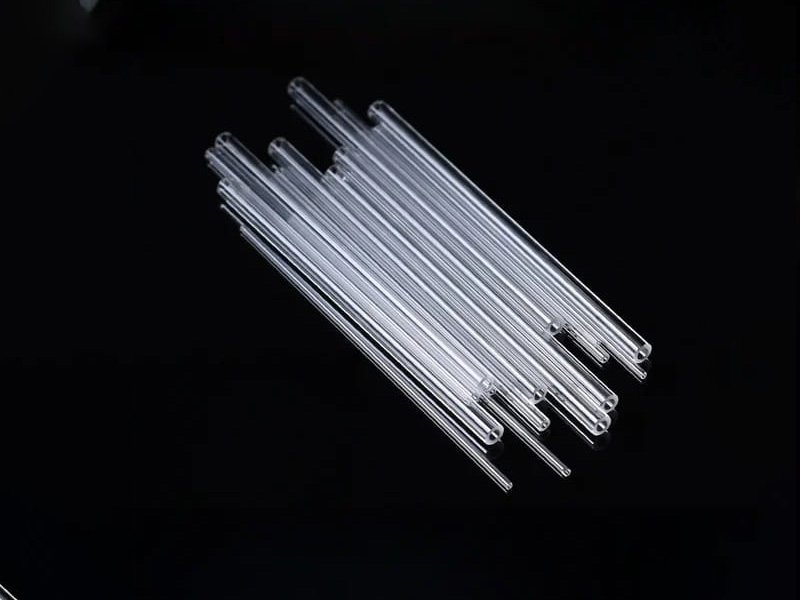
Discs, rings, holes, slots and profiles made to drawing with protected optical surfaces.
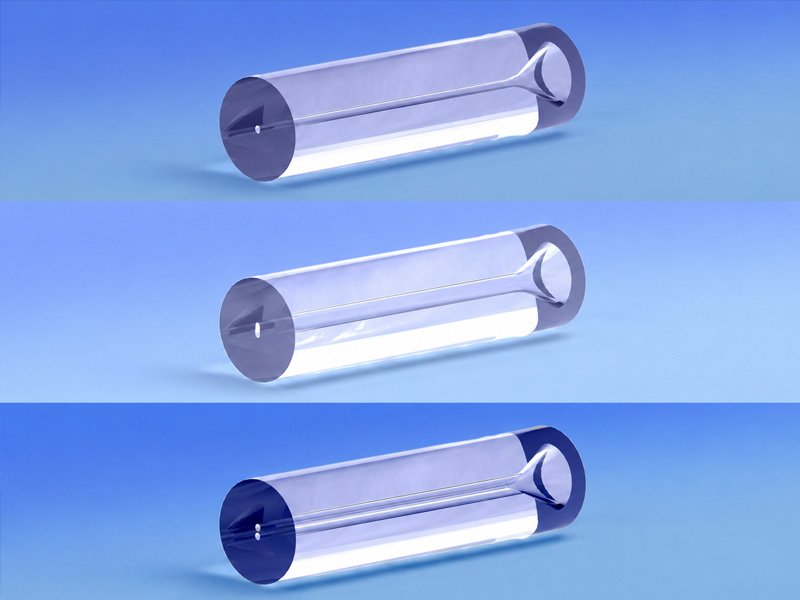
Surface quality, flatness, wedge, homogeneity and coating defined for the optical path.
The terms overlap in ordinary trade, but procurement should make the raw-material and optical grade explicit.
| Decision | Natural Fused Quartz | Synthetic Fused Silica |
|---|---|---|
| Starting material | High-purity natural quartz crystal/sand | Chemical silicon precursor |
| Typical strength | Good thermal and broad industrial use | Deep-UV and tightly controlled optical/purity grades |
| Metal contamination | Very low, grade dependent | Can be lower, grade dependent |
| OH content | Low- or medium-OH routes available | High- or low-OH synthetic routes available |
| Selection question | Is industrial purity and spectrum sufficient? | Does UV, homogeneity or contamination justify the grade? |
Typical family-level data for initial selection. Use the named grade data sheet and project conditions for final design.
A statement such as 'over 92 percent transmission' is only meaningful when the wavelength, thickness, surface finish and measurement method are known. A grade that performs well in visible light may show absorption in the UVC or IR region.
Specify the operating band and minimum transmission at the finished thickness. For coated windows, add angle of incidence, coating side and whether the limit is average or point-by-point.
Reference regions only. Request a grade- and thickness-specific spectral curve.
Fused silica can crystallize at elevated temperature when the surface is contaminated or held in unsuitable conditions. Alkali and alkaline-earth traces can accelerate this change, producing haze and reducing useful life.
Use clean handling, compatible fixtures and a defined cleaning method. The operating atmosphere and contact material should be stated for long-duration high-temperature parts.
Quartz inspection changes with the job: an industrial heater shield and a UVC optical window do not need the same control plan.
Confirm material grade, thermal profile, atmosphere, optical task, geometry and assembly constraints.
Lock datums, edge profiles, holes, critical zones and the named substrate before fabrication.
Cut or CNC the part, grind edges and complete holes or slots before any incompatible downstream process.
Apply printing, strengthening, coating, polishing or cleaning in the validated sequence.
Release dimensions, surface quality and functional tests, then protect critical faces for shipment.
Inspection conditions and acceptance limits follow the approved drawing, material grade and validation plan.
Use grade language that can be connected to a data sheet and inspection plan.
They are often used as overlapping trade terms. For technical procurement, distinguish natural fused quartz from synthetic fused silica and name the grade.
Use a UV-grade material with a thickness-specific transmission curve at the required wavelength. Visible clarity alone does not prove UVC performance.
It depends on grade, duration, geometry, atmosphere, surface contamination and support. Use the material data sheet and application review rather than one universal number.
Yes, for suitable geometries. Holes, slots, edge distance, wall thickness and surface protection need process review.
No. OH content, inclusions, homogeneity, birefringence, surface quality and the target wavelength may control performance.
Application-specific coatings can be reviewed by wavelength, angle, surface quality, temperature and coating durability.
Include: Natural or synthetic preference | Wavelength and transmission target | OH, purity, homogeneity or inclusion requirement | Drawing, thickness and surface quality | Temperature cycle and atmosphere | Coating, cleaning and packaging | Quantity and inspection documentation.
The correct fused silica route begins with the optical band and contamination boundary, not only the outline dimensions. We return a proposed material and process route, open technical questions, sample plan and inspection points for approval.
Tell us the material, size, thickness, tolerance, quantity, application, and any holes, slots, edges, coating, printing, or polishing requirements. We can manufacture custom glass components from your drawing, CAD file, sketch, or sample.