
Two anti-glare samples can have similar gloss readings and still look different on a display. One may preserve fine text; another may look grainy on a white screen. The result is not necessarily a bad measurement. The measurements may be describing different optical effects.
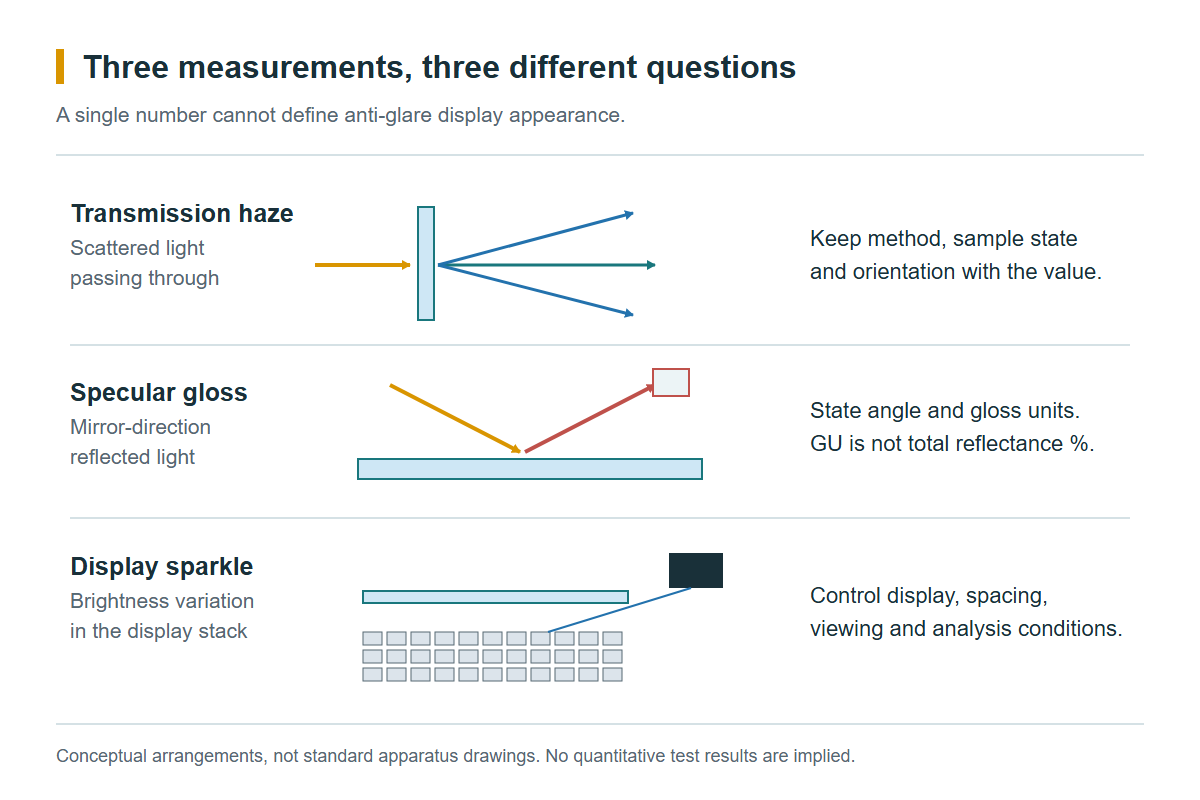
Gloss concerns reflected light near the mirror direction. Transmission haze concerns scattered light passing through the sample. Sparkle concerns spatial brightness variation produced by the interaction between an AG structure and a display. None of these is a complete substitute for the others.
Read “Haze” with the Measurement Direction Attached
Transmission haze and reflection haze are not the same quantity. A report that simply says “haze 8%” leaves out information needed to interpret it.
BYK’s transparency guidance distinguishes total transmission, transmission haze and clarity. In the ASTM D1003-type explanation, haze concerns transmitted light scattered more than 2.5 degrees from the incident direction; clarity concerns narrower-angle scattering. A sample can therefore transmit substantial light and still affect the appearance of fine detail. The method and its stated range need to suit the sample. BYK transparency measurement guidance
When comparing reports, first check whether the measured object is bare glass, a film or a completed display stack. Ask which surface faces the instrument and whether an adhesive or air gap is present. These are not minor administrative details when the sample is textured and directional.
Gloss Needs an Angle and a Unit
Gloss readings are usually expressed in gloss units, GU, using a specified measurement geometry and reference. A result reported at 60 degrees cannot simply be compared with one reported at 20 degrees. It is also not a direct statement that the glass reflects that percentage of all incident light.
Rhopoint describes gloss, reflectance haze and distinctness of image as separate measurements. Its instruments use defined geometries, including 20-, 60- and 85-degree options. Nippon Denshoku likewise explains specular gloss as a comparison with a reference under the same angular conditions. Rhopoint measurement definitions, Nippon Denshoku gloss measurement
Sparkle Must Be Evaluated with the Display
Sparkle can appear as fine brightness variation over a lit screen. AG microstructure that diffuses ambient reflections can also modify light from the pixel pattern. Assessing a loose glass coupon against a printed sheet does not reproduce that interaction.
Radiant Vision Systems describes sparkle as the interaction of AG surface structure with display-pixel geometry. Its metrology work also shows why working distance, focus, analysis region, moire and brightness gradients need control in repeatable measurements. A numeric limit is meaningful within an agreed method, not as an instrument-independent quality grade. Radiant sparkle measurement study
For a new panel, evaluate the intended display and cover spacing, or a documented representative stack. Use a white or mid-gray field to inspect graininess, then fine text and thin lines to inspect readability. Include the expected viewing distance and illumination, rather than judging only at an unusually close distance in a dark room.
Turn the Visual Approval into a Repeatable Specification
| Property | What it helps answer | Information to keep with the result |
|---|---|---|
| Transmission haze | How much transmitted light is scattered under the stated method? | Method, instrument, sample construction and orientation |
| Gloss | How strong is the mirror-direction reflection under this geometry? | Angle, GU, reference and sample support |
| Sparkle | Is the lit display visibly grainy through this cover? | Display, spacing, content, distance and analysis method |
| Image clarity | Are fine details preserved in the intended viewing task? | Pattern, viewing conditions and agreed reference sample |
Start with samples that perform acceptably in the actual viewing task. Then agree the measurable controls that distinguish them from unacceptable samples. Retain a reference sample and a description of the visual test, so a new inspection team can reproduce the approval.
Do not request the lowest possible gloss, haze and sparkle independently without considering whether the combination is achievable and useful. Each number describes part of the optical behavior. The purchasing goal is readable information under the required lighting, not a datasheet full of individually impressive values.
For surface options, visit Anti-Glare AG Glass. If reflection intensity remains the problem after texture selection, read why AG and AR are sometimes combined.