
For an industrial touch panel, the material choice should follow the failure risk and the assembly, not a simple “strong glass versus ordinary glass” comparison.
Chemically strengthened cover-grade aluminosilicate glass is a strong candidate for thin, frequently handled or exposed interfaces. Soda-lime glass remains a practical candidate for protected, cost-sensitive panels where the required geometry and strengthening route meet the design. Neither material name guarantees impact performance, touch response or long-term appearance.
The distinction matters because an industrial panel may need to survive a dropped tool, repeated wiping, vibration and years of operation. These are different requirements, and a single hardness or bending-strength number cannot represent all of them.
Compare the Finished Cover, Not Two Unspecified Glass Families
“Aluminosilicate” includes many compositions. Some are designed for chemical strengthening as display covers; others are intended for entirely different applications. Even specialist cover grades can have different strengthening responses and thermal properties. SCHOTT’s Xensation technical details list separate properties for different compositions.
Soda-lime products also need a defined condition: annealed, thermally toughened or chemically strengthened where the selected grade and process support it. Comparing a strengthened speciality cover with annealed float glass says more about the treatments than a neutral family-to-family comparison.
Before reviewing price, identify the offered grade, thickness, edge condition, holes and strengthening condition on both quotations.
Why Chemical Strengthening Matters for Thin Covers
In a common ion-exchange process, larger potassium ions replace smaller sodium ions near the glass surface. The constrained surface layer develops compression, helping resist tensile loading that would otherwise extend surface flaws. Corning explains this mechanism in How It Works: Strengthening Glass.
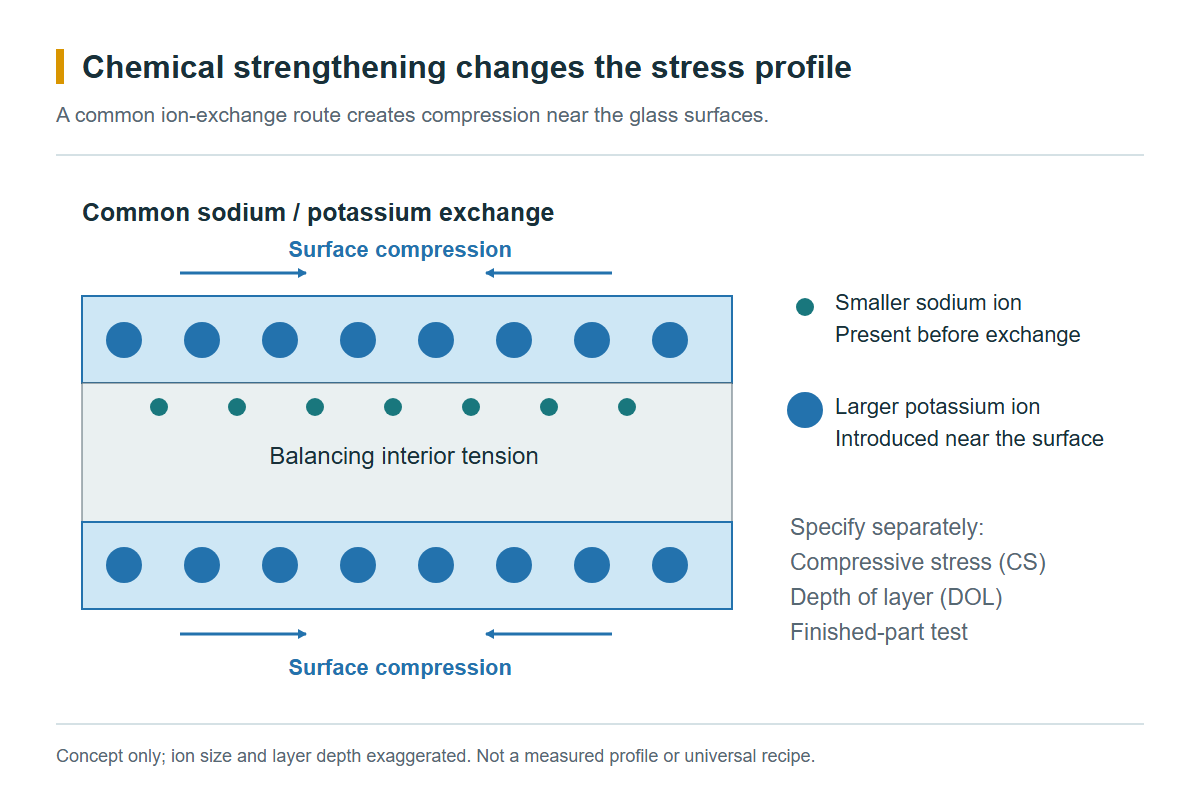
The two specifications most often discussed are surface compressive stress (CS) and depth of layer (DOL). They describe different aspects of the strengthening profile. A high CS value is not a substitute for sufficient protection against the damage modes relevant to the panel.
Grade-specific data illustrate why the recipe matters. The Xensation 3D datasheet reports strengthening capabilities for a named lithium aluminosilicate glass and explicitly conditions them on a specialised process. Those values should not be adopted as generic aluminosilicate acceptance limits.
For a thin cover, confirm which strengthening route is achievable in its actual thickness and shape. Thermal toughening and chemical strengthening are different processes; one is not a blanket substitute for the other.
Where Each Material Becomes a Sensible Candidate
| Design condition | Aluminosilicate cover grade | Soda-lime grade |
|---|---|---|
| Thin cover with a demanding damage requirement | Evaluate a grade and ion-exchange profile designed for this task | Verify whether the proposed thickness and treatment can meet the same test |
| Recessed panel protected by a bezel | May be justified if damage or thinness still drives the design | Worth evaluating where the bezel limits exposure |
| Tight cost target at an already-qualified thickness | Compare the performance benefit with total finished-part cost | Often a useful baseline candidate; confirm actual quotation and yield |
| Frequent cleaning or difficult ambient lighting | Specify coating, surface and durability separately | Specify coating, surface and durability separately |
| Holes, slots or vulnerable corners | Review processed-edge quality and local loads | Review processed-edge quality and local loads |
These are selection directions, not promised performance. Final impact results depend on the finished part and mounting. Corning’s controlled edge-damage study shows why mechanical contact at an edge can create strength-limiting flaws even when the original surface is well controlled.
Touch Sensitivity Belongs to the Whole Stack
Changing the cover material is not an automatic touch-sensitivity upgrade. In a projected-capacitive system, cover thickness, dielectric properties, sensor geometry, bonding and controller configuration contribute to the response.
Glass thickness and any unintended gap between layers can matter as much as the family name. Microchip discusses front-panel material and thickness in its touch sensor design guidance and covers touch-cover effects in AN2934: Capacitive Touch Sensor Design.
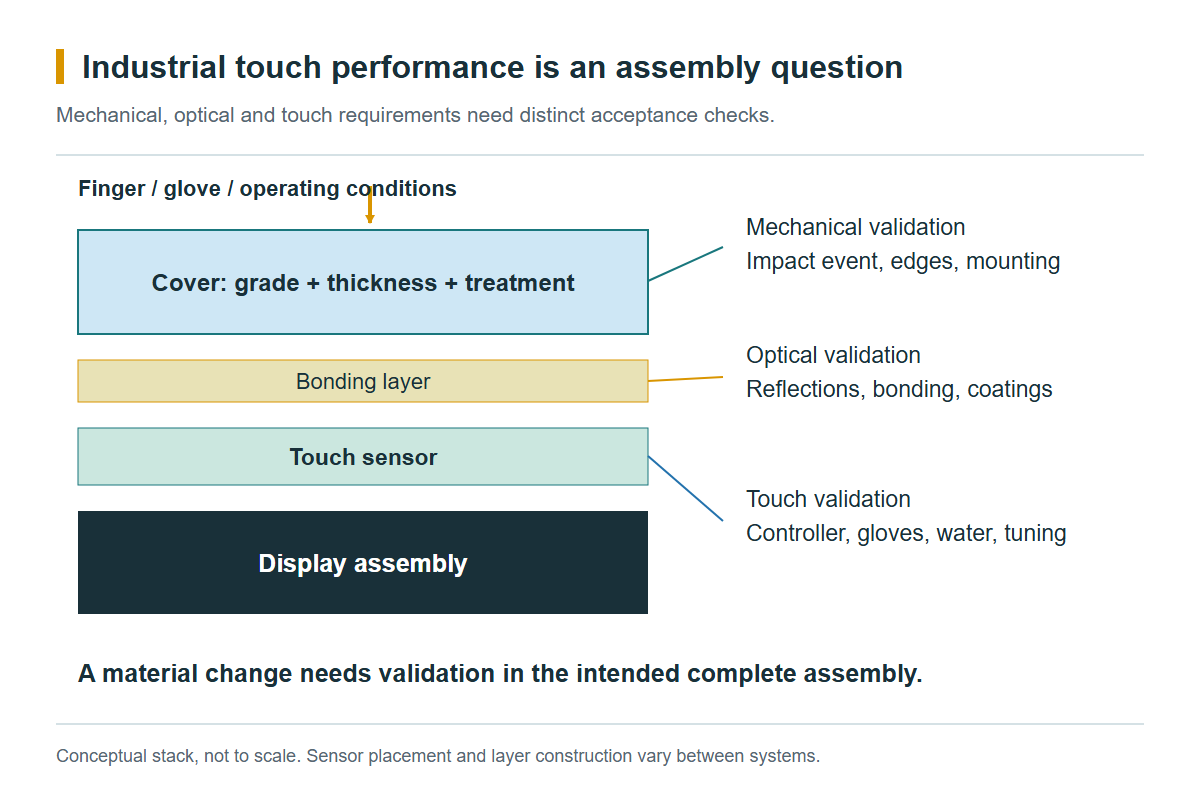
Validate the proposed cover using the intended sensor and controller, including required gloves and any wet-operation mode. Conductive or antistatic layers need their own electrical review. A mechanical material substitution should not quietly become an untested change to the touch system.
Two Panel Designs, Two Different Buying Decisions
An exposed, thin control display: The cover has little protection from the bezel, and the system requires a slim front assembly. A cover-grade aluminosilicate candidate is worth evaluating against the specified impact event, edge protection and post-damage performance. Its value must appear in the tested assembly, not just in a supplier’s undamaged-glass figure.
A recessed machine HMI: The cover sits behind a protective bezel, the accepted thickness is less restrictive, and a qualified soda-lime construction already meets the load case. A switch to aluminosilicate is not automatically necessary. Compare failures observed in service, optical requirements and total manufacturing cost before redesigning the cover.
These are hypothetical design scenarios, not SpecialGlass customer cases. They illustrate why the same material decision should not be repeated across every industrial panel.
Put the Acceptance Test Into the Drawing Package
Specify the finished outline, critical holes, edge finish and strengthening condition, then define the assembly test that decides acceptance. For an impact test, the impactor, energy, location, support and pass criterion must be stated; a force or height without the rest of the method is incomplete.
Treat appearance and touch response as separate checks. Assess required cleaning cycles, cosmetic limits and coatings alongside mechanical qualification. Do not describe chemically strengthened glass as scratch-proof or unbreakable.
For industrial touch panels, aluminosilicate earns its place when the selected grade and process solve a real thinness or damage problem. Soda-lime earns its place when a properly specified, tested construction meets the same application without unnecessary cost.
Material and product information: Aluminosilicate Glass, Soda Lime Glass, Touch Screen Cover Glass and Industrial HMI Glass.