
The main difference signalled by borosilicate 3.3 and borosilicate 4.0 is their nominal linear thermal expansion. The numbers refer to approximately 3.3 x 10^-6 and 4.0 x 10^-6 K^-1, respectively. They are material designations, not glass thicknesses.
If dimensional stability under the same temperature change is the only comparison, the lower-expansion 3.3 designation has the advantage. Choosing a finished part requires more than that comparison: the exact grade, product form, processing route and operating conditions still matter.
Start With the Designation, Then Check the Datasheet
Borosilicate glass 3.3 has an international material-properties reference: ISO 3585: Borosilicate Glass 3.3 – Properties. A familiar flat-glass example is BOROFLOAT 33, whose supplier publishes a mean CTE of 3.25 x 10^-6 K^-1 over 20-300 degrees Celsius, rather than exactly 3.300. See the manufacturer’s technical sheet.
Borosilicate 4.0 is also a real commercial designation. Yaohua lists a separate borosilicate float glass 4.0 range, while Hexad identifies 3.3 and 4.0 among its borosilicate material options. These commercial labels do not make every supplier’s product identical.
For a 4.0 quotation, ask for the actual CTE value, its tolerance and measurement interval. Do not assume that a 4.0 designation follows the same material specification as ISO 3585’s 3.3 glass.
The Expansion Difference in One Small Window
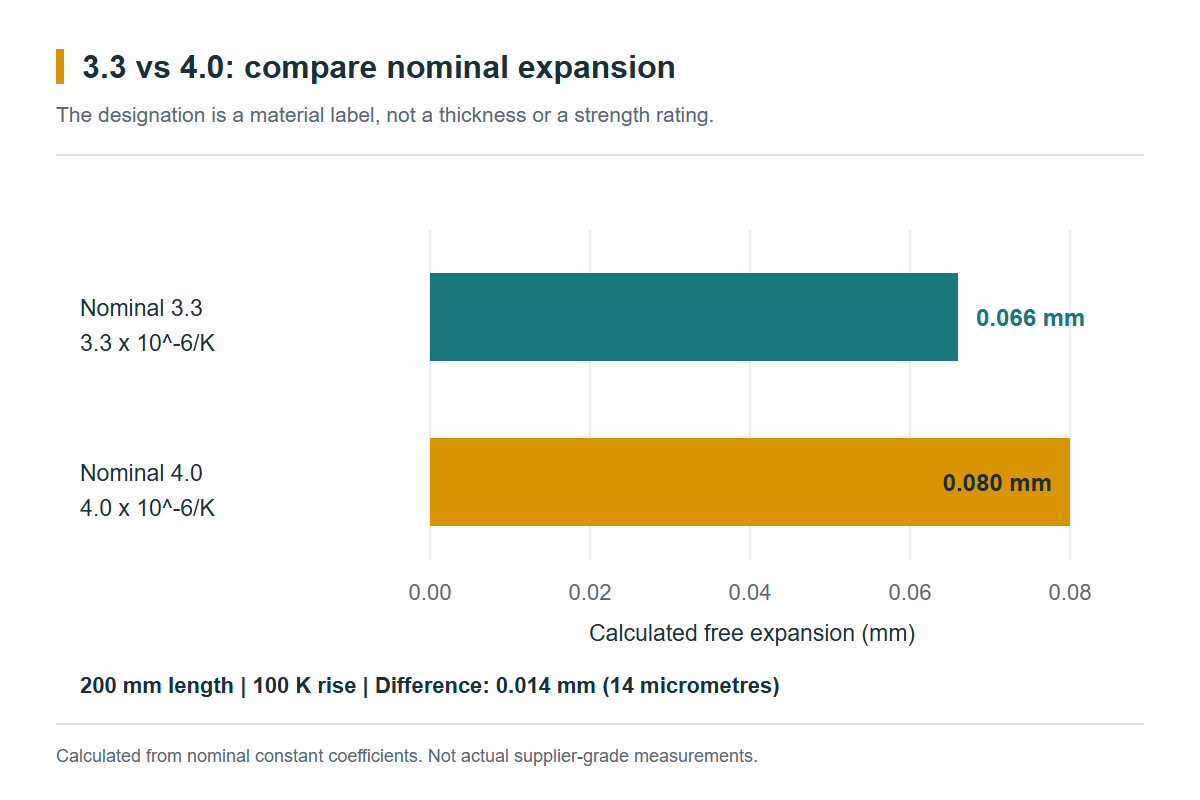
Take a 200 mm free-standing length and a 100 K uniform temperature rise. Using the nominal numbers only:
| Calculation input or result | Borosilicate 3.3 designation | Borosilicate 4.0 designation |
|---|---|---|
| Assumed constant CTE | 3.3 x 10^-6 K^-1 | 4.0 x 10^-6 K^-1 |
| Original length | 200 mm | 200 mm |
| Temperature rise | 100 K | 100 K |
| Calculated free expansion | 0.066 mm | 0.080 mm |
The difference is 0.014 mm, or 14 micrometres. The 4.0 nominal value produces about 21% more free expansion than 3.3 under these assumptions. Conversely, 3.3 produces about 17.5% less expansion than 4.0; the percentage depends on which value is the baseline.
Those percentages do not mean 21% less thermal-shock resistance or 21% lower mechanical strength. A dimensional-change ratio cannot be converted directly into a failure rating.
What the Two Numbers Leave Unanswered
Neither designation alone establishes bending strength, flatness, surface quality, optical transmission or a safe pressure load. It also does not confirm whether the finished glass is annealed, strengthened, coated or laminated.
A buyer comparing two quotations should therefore compare equivalent conditions. An annealed 3.3 plate and a strengthened 4.0 plate are not simply two different CTE numbers. Their fabrication history is part of the product specification.
Chemical resistance needs a similar check. A statement such as “borosilicate is chemically resistant” is not a substitute for the offered grade’s response to the actual medium, concentration, temperature and exposure time. For tubing, the DURAN manufacturer brochure separates chemical, mechanical and thermal guidance rather than reducing suitability to the expansion designation.
Choose Around the Product You Need to Manufacture
For a drawing-based technical window, begin with the thermal cycle, optical task and mounting. Lower expansion is attractive where thermal movement is important, but the available thickness, finished dimensions, edge quality and secondary processing must support the drawing.
For tubing or a formed component, verify the actual tube or forming-grade supply. A catalogue entry for flat float glass is not evidence that an equivalent tube or rod is available in the same grade and dimensions.
For fire-resistant glazing, start with the required tested assembly, not with “4.0” in the material name. The frame, seals, pane dimensions, glass construction and installation conditions belong to the approval. A material designation alone is not a fire-resistance certificate, and integrity performance should not be confused with insulation performance.
Ask for These Details Before Accepting a Substitute
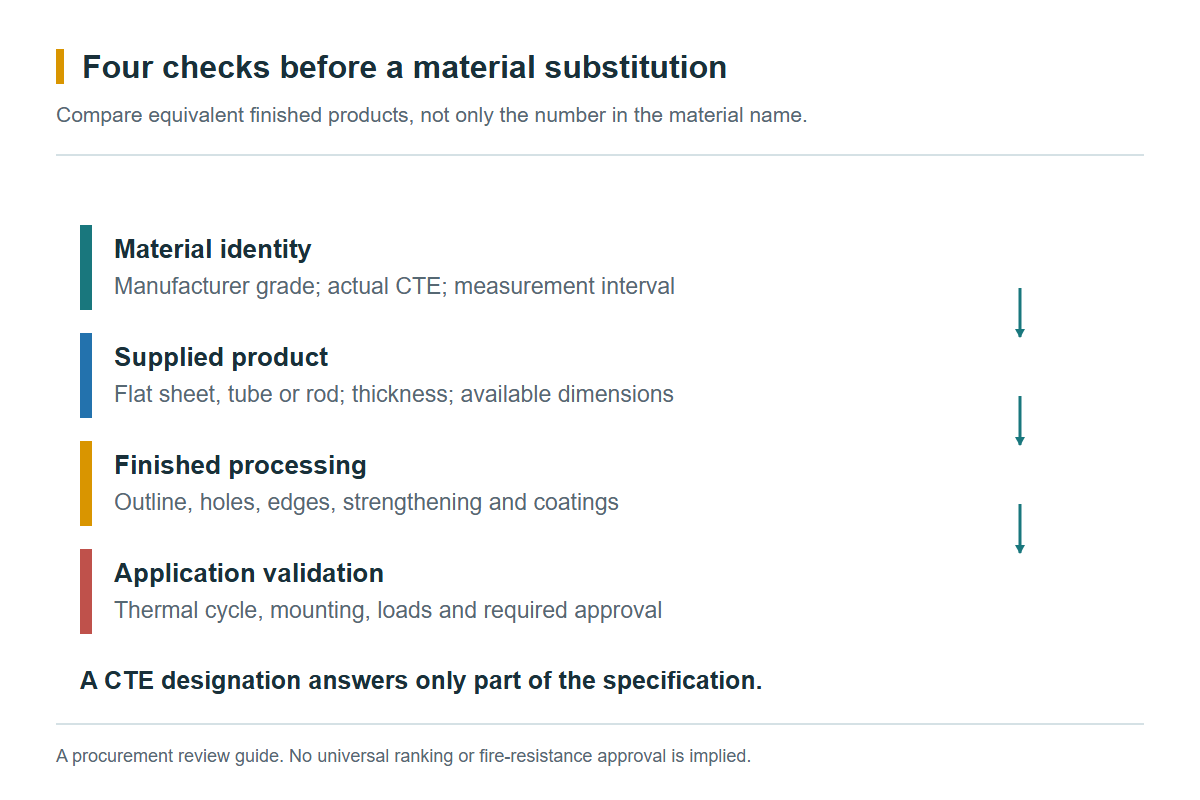
A substitution proposal should identify the manufacturer’s grade and datasheet revision; the CTE value and interval; the supplied product form and thickness; and the final processing condition. Then compare the application-critical requirements rather than accepting “equivalent borosilicate” as a complete description.
For an existing design, the safest starting point is its original material specification. If the proposed grade differs, qualify the change using the loads and geometry that made the original specification necessary.
In short: 3.3 denotes lower nominal expansion than 4.0. Whether that difference decides the purchase depends on the part, not just the label.
Explore Borosilicate Glass or continue with how CTE becomes a dimensional change.