
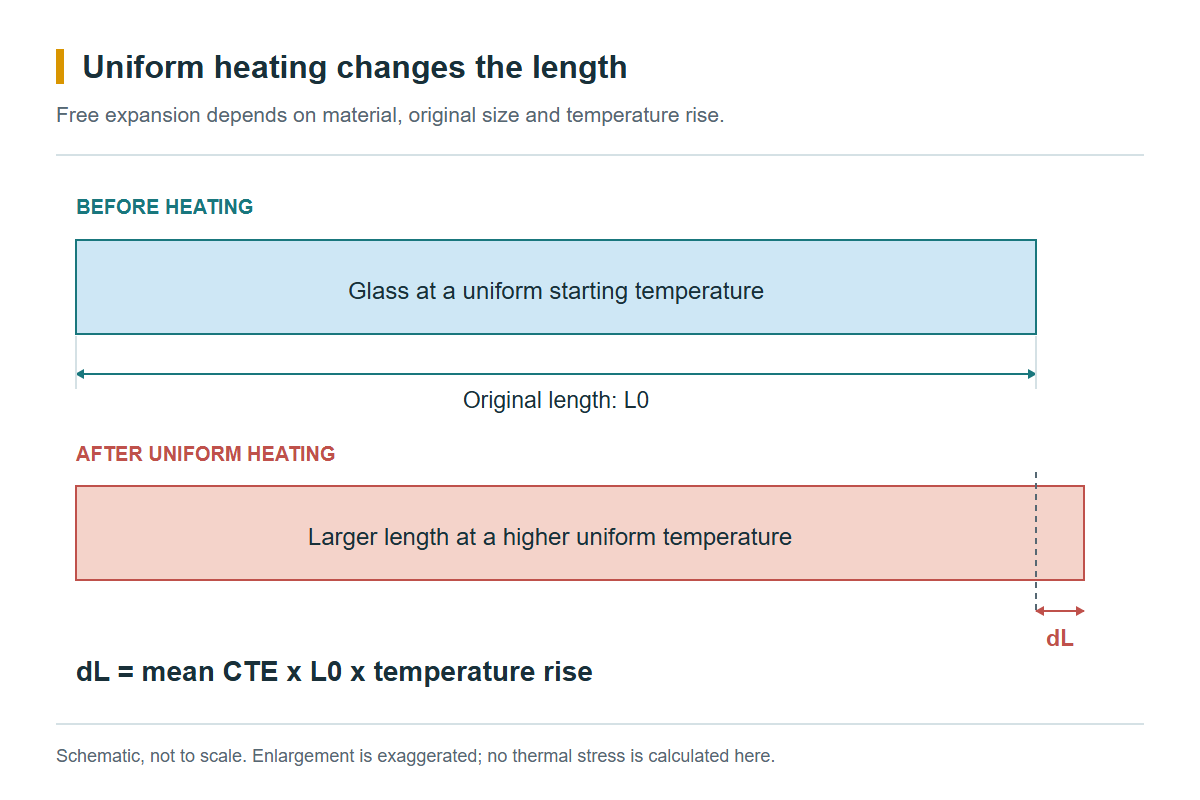
The thermal expansion coefficient of glass describes how much its size changes when its temperature changes. For a glass window, plate or tube, the most useful value is usually the coefficient of linear thermal expansion, often shortened to CTE.
A lower CTE means less dimensional change for the same length and temperature rise. It does not, by itself, specify a safe operating temperature, a pressure rating or the temperature change that a finished part can survive.
What a CTE Number Actually Means
CTE is commonly written in K^-1, per degree Celsius, or ppm/K. A temperature difference of 1 K is the same size as a difference of 1 degree Celsius, so the numerical coefficients are equivalent when expressed on these two scales.
For example, 3.3 x 10^-6 K^-1 means approximately 3.3 parts per million of linear dimensional change per kelvin. A 1,000 mm length would therefore grow by about 0.0033 mm for a 1 K rise, assuming the coefficient remains constant over that small interval.
The number is a relative change, not an amount in millimetres. A long panel moves more than a short panel made from the same glass because there is more original length to expand.
Typical Values Need a Material Name and a Temperature Interval
Glass is not one composition. Even within a material family, suppliers publish values for particular grades and measurement intervals.
| Named material example | Published mean linear CTE | Temperature interval |
|---|---|---|
| SCHOTT BOROFLOAT 33, borosilicate flat glass | 3.25 x 10^-6 K^-1 | 20-300 degrees Celsius |
| Corning Code 7740, soda borosilicate | 3.25 x 10^-6 per degree Celsius | 0-300 degrees Celsius |
| SCHOTT AR-GLAS, soda-lime technical tubing glass | 9.1 x 10^-6 K^-1 | 20-300 degrees Celsius |
These are grade-specific examples, not acceptance limits for every borosilicate or soda-lime product. AR-GLAS is a material trade name here; it does not mean an anti-reflective coating. The original values are available in the BOROFLOAT 33 technical sheet, Corning 7740 material sheet and AR-GLAS technical sheet.
A mean CTE describes behaviour averaged over the stated interval. Do not extend a room-temperature coefficient through the glass transition or towards softening and expect an accurate dimensional prediction.
Calculate Expansion in Millimetres
For a first estimate under uniform heating:
Change in length = CTE x original length x temperature change
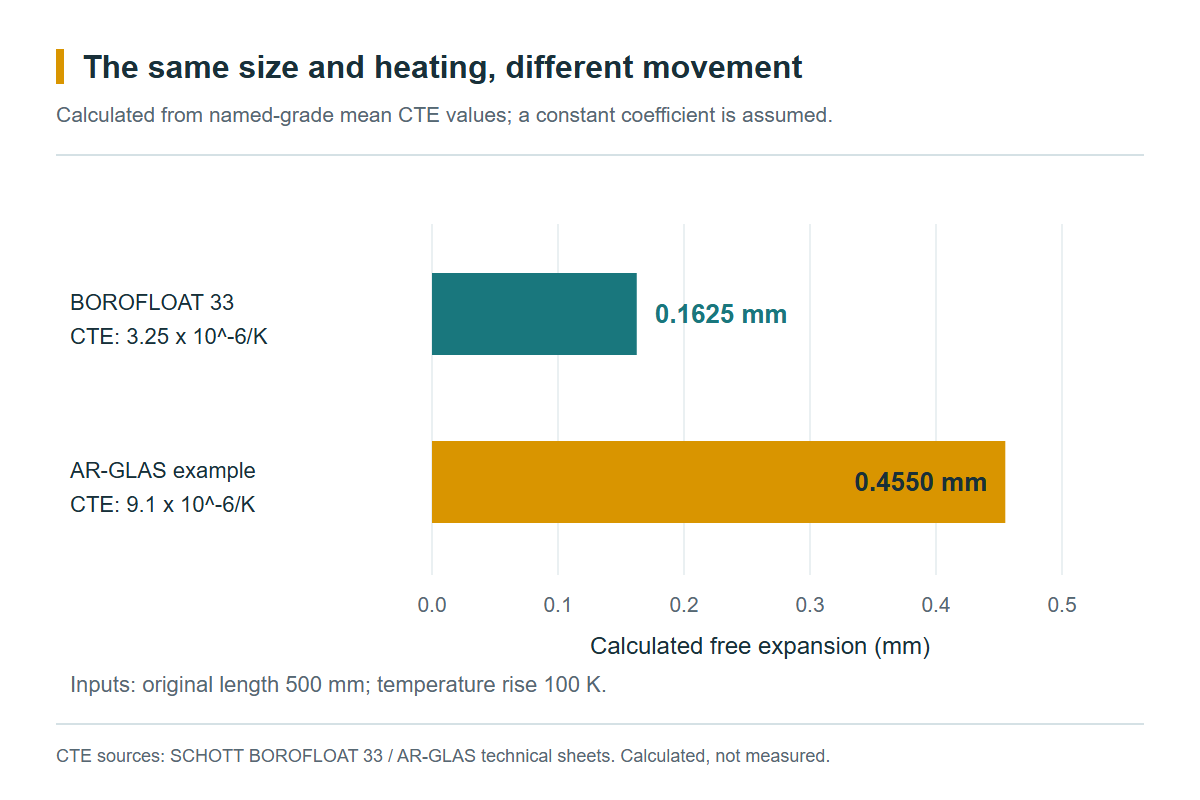
Consider a 500 mm plate heated from 20 to 120 degrees Celsius. The temperature rise is 100 K. Using the published coefficients above as constant approximations:
BOROFLOAT 33:
3.25 x 10^-6 x 500 x 100 = 0.1625 mm

AR-GLAS material example:
9.1 x 10^-6 x 500 x 100 = 0.4550 mm
The second result is about 2.8 times the first. This compares free expansion only. It is not a comparison of breakage probability, strength or maximum service temperature, and the mean coefficients are not exact measurements specifically for 20-120 degrees Celsius.
Why a Small Movement Can Matter in a Large Assembly
A few tenths of a millimetre may look insignificant until the glass is bonded into a frame, located against a hard stop or held by a close-fitting fastener. The important question becomes: can the glass and the surrounding parts move without forcing one another?
A free plate can expand. A restrained plate develops mechanical loads instead. Differential expansion also matters when two bonded materials want to change size by different amounts. SCHOTT discusses CTE matching as a central consideration in its glass-to-metal sealing guidance.
For a machined window, review the locating method, gasket compression, adhesive behaviour and temperature distribution together. The expansion calculation is an input to that review, not a ready-made mounting clearance. Assembly tolerances and loads still have to be considered.
CTE and Thermal Shock Are Related, but Not Interchangeable
CTE asks how much glass wants to expand. Thermal shock asks what happens when different regions of the glass change temperature at different rates. Less expansion can help, but the outcome also depends on geometry, heat transfer and the condition of the finished part.
For selection, request the named material, its CTE interval and the actual operating cycle. For a dimensional fit problem, start with the expansion calculation. For rapid heating or cooling, continue with how thermal shock develops in glass.
Related material information: Borosilicate Glass and Soda Lime Glass.