
An inquiry for “10 mm glass that can withstand 10 bar” is missing the dimensions and support that make a pressure review possible. A small supported opening and a wide unsupported window do not place the same demand on a sheet of the same thickness.
A pressure rating belongs to a defined window or assembly under stated conditions. It should not be transferred to an arbitrary glass disc merely because the material and thickness match.
Outside Diameter and Viewing Aperture Are Different Dimensions
The outside diameter describes the disc that fits the housing. The aperture describes the opening exposed to pressure and available for viewing. The support region and boundary conditions determine how that exposed area is carried. All three need to appear in the installation drawing.
For a simple force comparison, uniform pressure acting over a circular exposed area produces a resultant force equal to pressure multiplied by area. Changing the exposed diameter from 50 mm to 75 mm increases that area by a factor of 2.25. This example compares total pressure force only; it does not calculate bending stress or an allowable pressure.
SCHOTT’s BOROFLOAT pressure-loading guidance uses defined circular and rectangular geometries, support assumptions and design-strength conditions. It also distinguishes mechanical loading from combined mechanical and thermal loading. These conditions are part of the calculation, not optional notes. SCHOTT pressure-loading guidance
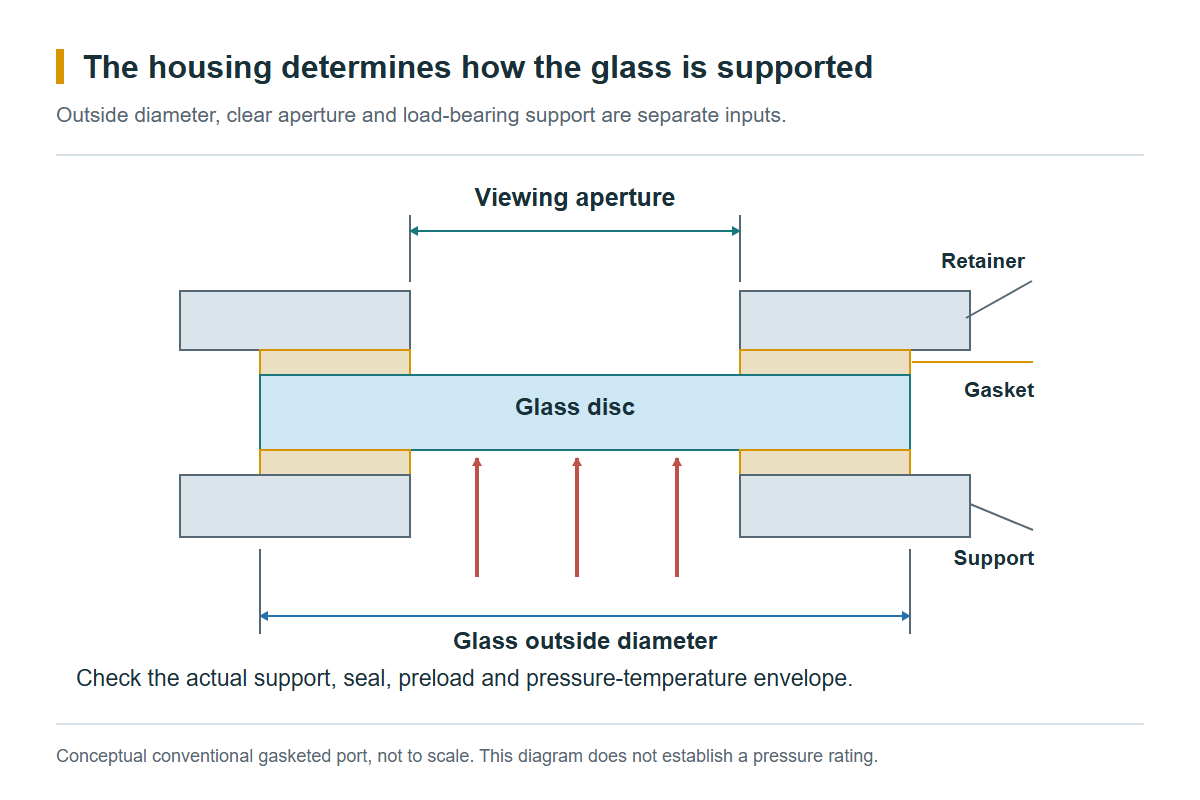
The Seal and Retainer Change the Load Path
A conventional port clamps glass between supporting components and seals. The glass does not experience pressure in isolation: flange flatness, support contact and clamp loading affect it too.
LJ Star’s design guidance describes how uneven tightening, inappropriate gasket support and nonparallel component faces can impose damaging loads on conventional glass windows. That is why an assembly should use the gasket, retainer and tightening instructions specified by its responsible manufacturer. More torque is not a general remedy for a leak. LJ Star sight-window design guidance
For a replacement, retain the equipment model and drawing revision. A disc that physically fits is not necessarily equivalent to the original specified window. Changing the gasket, thickness or support should be reviewed as a design change, rather than treated as routine substitution.
Review Pressure and Temperature Together
Maximum pressure and maximum temperature shown in different places on a datasheet may not be permissible simultaneously. The allowable operating envelope must describe the combination, including pressure direction, vacuum where relevant and temperature changes during startup or cleaning.
SCHOTT’s loading guide explains that thermal stresses must be considered alongside mechanical stresses. Its examples do not create a universal pressure chart for all finished borosilicate parts. Similarly, a published room-temperature test does not by itself establish hot-service performance. SCHOTT mechanical and thermal load examples
If the outside is sprayed with cleaning liquid while the inside remains hot, the event introduces a temperature gradient as well as the existing pressure load. Record the cleaning sequence and likely temperature difference. See what thermal shock means for glass for the mechanism.
A Pressure Test Applies to the Tested Construction
Manufacturers may offer different constructions, including conventional gasketed glass and glass fused into a metal ring. Those are not interchangeable simply because both provide a transparent aperture.
For example, LJ Star’s METAGLAS technical information ties operating-pressure capability to design and size and describes manufacturer pressure tests at room temperature. That product’s test results belong to its stated construction and procedure; they are not evidence for the capability of a separate custom glass plate. METAGLAS technical information
The test record should identify the assembly, pressure, temperature, duration and acceptance basis. Also distinguish a proof test from the working-pressure rating. For regulated equipment, use the applicable design and inspection requirements and a competent responsible engineer.
Send an Operating Envelope, Not a Thickness Request
A useful inquiry includes the clear aperture and outside dimensions, glass thickness and grade, support section, seals, operating and design pressure, temperature range, medium and cleaning exposure. State whether the request concerns replacement glass, a new custom component or a complete port.
The result should be a proposed construction with a defined validation basis, not a bare assurance that “borosilicate withstands pressure.” Until that review is complete, no pressure value should be treated as an approved operating rating. Never loosen or service a pressurized or hot port; follow the equipment manufacturer’s isolation and maintenance procedure.
For material background, see Borosilicate Glass.