
Borosilicate glass and glass ceramic are both used where ordinary soda-lime glass cannot provide enough thermal stability.
But they are not interchangeable.
The main difference is not simply that one material can “handle more heat.” The more important question is how the material behaves when temperature changes across the glass, when one area is much hotter than another, or when the part repeatedly heats and cools.
In general:
- Borosilicate glass is a good choice when moderate-to-high temperature resistance, transparency, dimensional accuracy and conventional glass processing are all important.
- Glass ceramic becomes more attractive when very low thermal expansion and severe thermal-shock resistance are the dominant requirements.
A typical borosilicate 3.3 material such as BOROFLOAT® 33 has a coefficient of thermal expansion of about 3.25 × 10⁻⁶/K between 20 and 300°C. SCHOTT lists maximum operating temperatures of 450°C for long-term use and 500°C for short-term use for this specific grade.
By comparison, a transparent fireplace glass-ceramic such as ROBAX® has a near-zero expansion coefficient of approximately 0 ± 0.5 × 10⁻⁶/K between 20 and 700°C. Its published data also shows resistance to temperature differences and thermal shock up to 700°C under defined conditions.
That difference in thermal expansion is usually the starting point when deciding between the two materials.
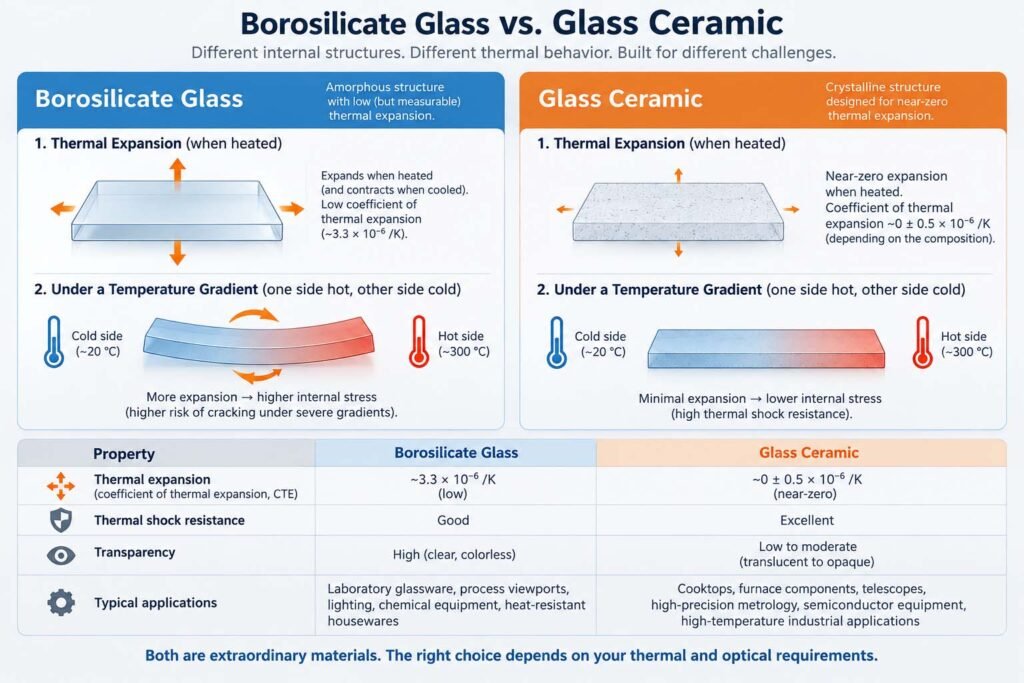
Borosilicate Glass and Glass Ceramic Are Different Materials
Borosilicate is still a conventional amorphous glass.
Its composition is modified with boron oxide to reduce thermal expansion compared with ordinary soda-lime glass. This gives it better resistance to thermal stress while retaining many of the processing and optical characteristics associated with glass.
Glass ceramic follows a different manufacturing route.
It is first produced as glass and then subjected to a controlled heat-treatment process that develops a fine crystalline phase within the remaining glass matrix. The crystalline and glass phases are engineered so that their thermal expansion behavior can partially or almost completely compensate for each other.
This is why certain glass-ceramics can achieve near-zero thermal expansion.
So although they may look similar as transparent sheets, their internal structures and thermal behavior are fundamentally different.
The Main Difference Is Thermal Expansion
When glass is heated, it expands.
If the entire panel heats uniformly, expansion alone may not cause a problem.
The more difficult situation occurs when different areas of the panel are at different temperatures.
For example:
- the center is exposed to a heating element
- the edges remain inside a cooler metal frame
- one surface faces a furnace
- the opposite surface is exposed to room air
- cold liquid contacts a hot panel
Different parts of the material try to expand by different amounts.
That creates internal stress.
The lower the coefficient of thermal expansion, the smaller this dimensional difference becomes.
A representative comparison is:
| Property | Borosilicate Glass 3.3 | Transparent Glass Ceramic |
|---|---|---|
| Typical CTE | ~3.25 × 10⁻⁶/K | Near 0 × 10⁻⁶/K |
| Thermal expansion | Low | Extremely low |
| Thermal-shock resistance | High | Very high |
| Transparency | High | High for transparent grades |
| Typical role | General heat-resistant technical glass | Severe thermal-gradient applications |
The glass-ceramic value above is representative of near-zero-expansion products such as ROBAX®, not every glass-ceramic formulation. BOROFLOAT® 33 data is similarly specific to that borosilicate grade.
This distinction matters because material selection should be based on a specified grade rather than only the family name.
Thermal Shock Can Matter More Than Maximum Temperature
A common mistake is to select heat-resistant glass only by asking:
What is the maximum temperature?
That number is important, but it does not describe the complete application.
Consider two situations.
Situation A
A glass window slowly heats from room temperature to 400°C, and the entire panel remains at a similar temperature.
Situation B
The center of the same panel reaches 400°C while the edges remain near 50°C.
The peak temperature is the same.
But Situation B produces a much larger temperature gradient and therefore much greater thermal stress.
This is where glass ceramic often has a major advantage.
Because its thermal expansion can be close to zero, large temperature differences across the panel produce much less expansion-related stress.
For example, ROBAX® data specifies no thermal-stress breakage under defined temperature-difference and thermal-shock conditions up to 700°C. It also lists temperature/time load values of 610°C for 1,000 hours and short-term exposure up to 760°C for that specific product.
Borosilicate glass also has good thermal-shock resistance, but it still expands more than near-zero-expansion glass ceramic.
For this reason, an application with strong local heating may require glass ceramic even when the nominal operating temperature appears to be within the range of borosilicate glass.
When Borosilicate Glass Makes More Sense
Glass ceramic is not automatically the better material simply because its thermal expansion is lower.
Borosilicate remains a very useful engineering material.
It is commonly chosen where the operating environment requires better thermal stability than soda-lime glass, but the thermal gradients are not extreme.
Typical examples include:
- industrial observation windows
- oven doors
- laboratory equipment
- lighting covers
- machine windows
- protective panels
- process equipment
- optical and technical components
Borosilicate is particularly useful when the component also requires conventional glass fabrication.
Depending on the design and thickness, parts can be produced with operations such as:
- cutting
- drilling
- CNC machining
- edge grinding
- polishing
- holes and slots
- printing
- coating
- thermal forming
Borosilicate glass therefore provides a practical balance between thermal performance, optical clarity and manufacturing flexibility.
For applications below the severe thermal-shock range, moving to glass ceramic may provide little practical benefit.
When Glass Ceramic Makes More Sense
Glass ceramic is generally considered when thermal expansion becomes the limiting factor.
Typical situations include:
- fireplace viewing panels
- stove windows
- burner covers
- high-temperature heater panels
- infrared heating equipment
- furnace-related components
- cooking surfaces
- applications with intense local heating
- applications with repeated rapid heating and cooling
The important phrase is:
intense temperature gradient
rather than simply:
high temperature
A panel next to an open flame or heating element may experience very different temperatures only a few centimeters apart.
Glass ceramic is well suited to these conditions because its dimensions change very little as temperature rises.
Fireplace Glass Is a Good Example
Fireplace doors clearly show the difference between these material families.
It is common to call the transparent panel “fireproof glass,” but the material used in many modern fireplaces is actually transparent glass ceramic.
Why?
The center of the panel can become extremely hot while the perimeter remains restrained by a much cooler metal frame.
This creates exactly the type of uneven heating that is difficult for conventional glass.
Near-zero thermal expansion significantly reduces the resulting thermal stress.
A borosilicate panel may be adequate for some controlled heat applications, but glass ceramic is normally a more appropriate choice where direct flame exposure and extreme temperature gradients are expected.
Material selection should still follow the fireplace or equipment manufacturer’s design and specified operating conditions.
Optical Appearance Can Also Affect the Decision
For many industrial applications, temperature is not the only requirement.
The user may also need to see clearly through the glass.
正在保存…
Borosilicate glass is widely used where good transparency and controlled optical properties are required.
For example, BOROFLOAT® 33 is produced as a float glass and is available with published refractive-index and optical-transmission data.
Transparent glass ceramics can also provide very good visibility, but glass-ceramic products exist in many forms.
Depending on their formulation and ceramization process, they may be:
- transparent
- tinted
- semi-transparent
- opaque
Controlled crystallization allows manufacturers to produce very different optical appearances.
This means “glass ceramic” alone is not enough information to define the optical performance.
The exact grade matters.
Do Not Select the Material From Temperature Alone
For an engineering project, a more useful material-selection discussion includes:
- continuous operating temperature
- short-term peak temperature
- heating and cooling rate
- maximum temperature difference across the panel
- direct flame exposure
- panel dimensions
- glass thickness
- edge condition
- mounting method
- mechanical loading
- required optical transmission
- chemical environment
- required holes or machined features
Mounting deserves particular attention.
Even a highly heat-resistant material can fail if the panel is clamped too rigidly or if the frame prevents normal dimensional movement.
Mechanical strength in glass and glass ceramic is also influenced by edge condition, holes, surface damage, component geometry and installation conditions.
Material selection and mechanical design therefore need to be considered together.
A Simple Selection Rule
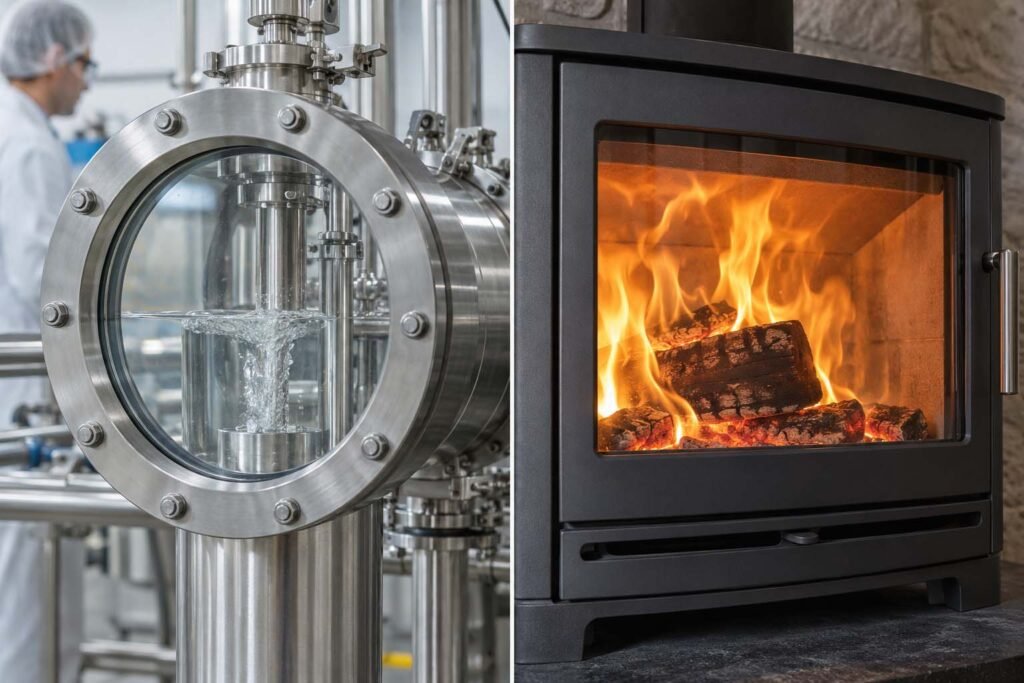
For early-stage material selection, the following guideline is useful.
Choose Borosilicate Glass When:
- the temperature is elevated but not extreme
- heating is reasonably uniform
- good optical clarity is important
- custom machining is required
- holes, slots or shaped parts are needed
- cost and manufacturing flexibility matter
Consider Glass Ceramic When:
- thermal gradients are severe
- the panel is close to flames or heating elements
- rapid heating and cooling occur repeatedly
- near-zero thermal expansion is important
- the application operates beyond the practical range of common borosilicate glass
This is not an absolute rule.
The exact material grade and actual operating environment still need to be checked.
Example: Choosing a Window for a 450°C Application
Suppose a customer asks:
We need a transparent window for equipment operating at 450°C. Should we use borosilicate or glass ceramic?
There is not enough information yet.
If the entire window gradually reaches approximately 450°C and remains relatively uniform, a suitable borosilicate grade may be worth evaluating. BOROFLOAT® 33, for example, lists 450°C as its long-term maximum operating temperature.
But suppose the equipment has:
- a 450°C hot zone in the center
- an aluminum or steel frame near room temperature
- rapid heating at startup
- cooling air flowing across one edge
The material may experience a much more severe thermal gradient.
In that situation, glass ceramic may become the more appropriate direction even though the nominal maximum temperature is still only 450°C.
This is why the question:
“What temperature can this glass withstand?”
is usually less useful than:
“What temperature distribution will the glass actually experience?”
Borosilicate vs Glass Ceramic: The Practical Difference
Borosilicate glass is designed to reduce thermal expansion.
Near-zero-expansion glass ceramic goes considerably further.
That difference determines where each material works best.
For general industrial heat-resistant windows, machine panels, lighting parts and technical components, borosilicate often provides a useful combination of thermal resistance, transparency and manufacturability.
For fireplaces, heating elements and other applications involving severe temperature gradients or repeated thermal shock, glass ceramic can provide a much larger thermal-performance margin.
The final selection should therefore be based on the complete operating condition rather than only the maximum temperature.
When specifying a custom heat-resistant glass component, provide the operating temperature, temperature gradient, component size, thickness, mounting method and required machining features. These details are usually enough to narrow the material choice before final drawing review.