
No. Tempered glass should not be cut, drilled, notched, or resized after tempering.
Unlike ordinary annealed glass, tempered glass already contains a controlled internal stress pattern. Cutting through the surface disturbs this balance and will normally cause the entire pane to fracture into small pieces.
This means the final size and almost all mechanical features must be completed before the glass enters the tempering process.
Why Does Tempered Glass Break When You Try to Cut It?
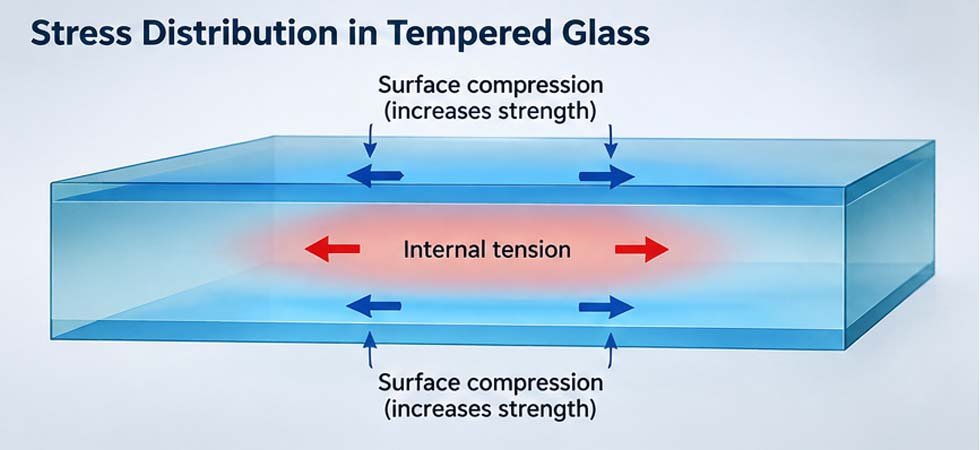
The reason is not that tempered glass is simply “too hard” to cut.
The real issue is internal stress.
During thermal tempering, the glass is heated and then rapidly cooled. The surfaces cool first and are placed into compression, while the interior develops tensile stress.
This stress distribution is what gives tempered glass its increased mechanical strength and characteristic break pattern.
As long as the pane remains intact, these stresses stay balanced.
A glass cutter, drill, grinding wheel, or CNC tool changes the edge or penetrates the compressed surface layer. Once that layer is disrupted, the stored stresses can be released and cracks can propagate rapidly through the pane.
Instead of producing a controlled cut, the glass usually fragments.
For this reason, cutting tempered glass is fundamentally different from cutting normal float glass.
What Must Be Done Before Tempering?
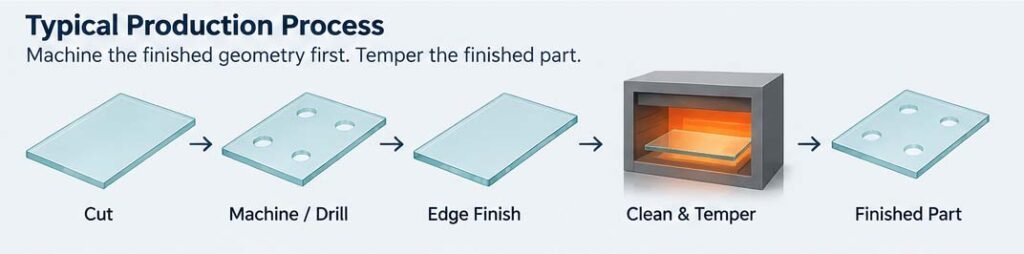
A custom tempered glass part should already have its final geometry before heat treatment.
Typical pre-tempering operations include:
- cutting to final length and width
- CNC profile machining
- round or shaped holes
- slots
- notches
- internal cut-outs
- countersunk holes
- corner radii
- edge grinding
- polished edges
- bevels or chamfers
For a simple rectangular panel, this may only mean confirming the finished dimensions and edge condition.
For an equipment window, cover glass, door panel, machine guard, or custom component, the drawing may also need to define the relationship between holes, slots, mounting hardware, gaskets, and the finished outside profile.
Once those features have been confirmed and machined, the part can be tempered.
A typical production sequence is therefore:
Cut → Machine → Drill → Edge Finish → Clean → Temper
Not:
Temper → Cut → Drill
Our glass cutting and CNC machining processes are therefore normally carried out before thermal strengthening when the finished part requires tempering.
Can You Drill Tempered Glass?
The same rule applies to drilling.
Conventional holes must be produced before tempering.
This includes:
- mounting holes
- handle holes
- countersinks
- through-holes
- slots
- hardware cut-outs
The issue is especially important for parts installed with bolts, hinges, clamps, sensors, or other hardware.
Hole diameter is only one part of the drawing. Hole position, edge distance, corner relationship and hardware clearance should also be confirmed before the part is released for tempering.
For more complex geometries, CNC machining can keep several features referenced to common datums before the strengthening step.
Can the Edges of Tempered Glass Be Ground Down?
Trying to correct the dimensions of tempered glass by aggressively grinding its edges creates the same basic problem.
Edge removal changes the finished geometry and interferes with the stressed glass structure. It can cause immediate breakage or weaken the finished pane.
Therefore, edge polishing, beveling, chamfering and dimensional edge grinding should be specified before tempering.
This is one reason accurate drawings matter for custom tempered components.
A difference that looks small on a CAD drawing can become impossible to correct after heat treatment.
What About Heat-Strengthened Glass?
Heat-strengthened glass also contains a heat-induced stress profile.
Although its stress level and break behavior differ from fully tempered glass, it should likewise be fabricated to its finished geometry before heat treatment.
The general manufacturing rule remains:
If an operation changes the glass size, edge, hole pattern or cut-out geometry, complete it before thermal strengthening.
Design the Finished Part Before Tempering
The most important issue is therefore not how to cut tempered glass.
It is how to avoid needing to cut it afterward.
Before ordering custom tempered glass, confirm:
- final width and height
- glass thickness
- outside profile
- corner radii
- hole diameter and position
- slots and notches
- internal cut-outs
- edge finish
- bevels or chamfers
- required tolerances
- coating or printing requirements
- mounting and hardware interfaces
For irregular parts, a dimensioned PDF together with DXF, DWG, or STEP geometry can reduce ambiguity during manufacturing.
Specialglass can combine CNC glass machining, drilling, edge processing and thermal strengthening according to the finished-part drawing.
The important point is simple:
Machine the geometry first. Temper the finished geometry afterward.
Once glass has been thermally tempered, cutting it to a new size is no longer a normal manufacturing option.