
Strengthening and Fragment Retention Solve Different Problems
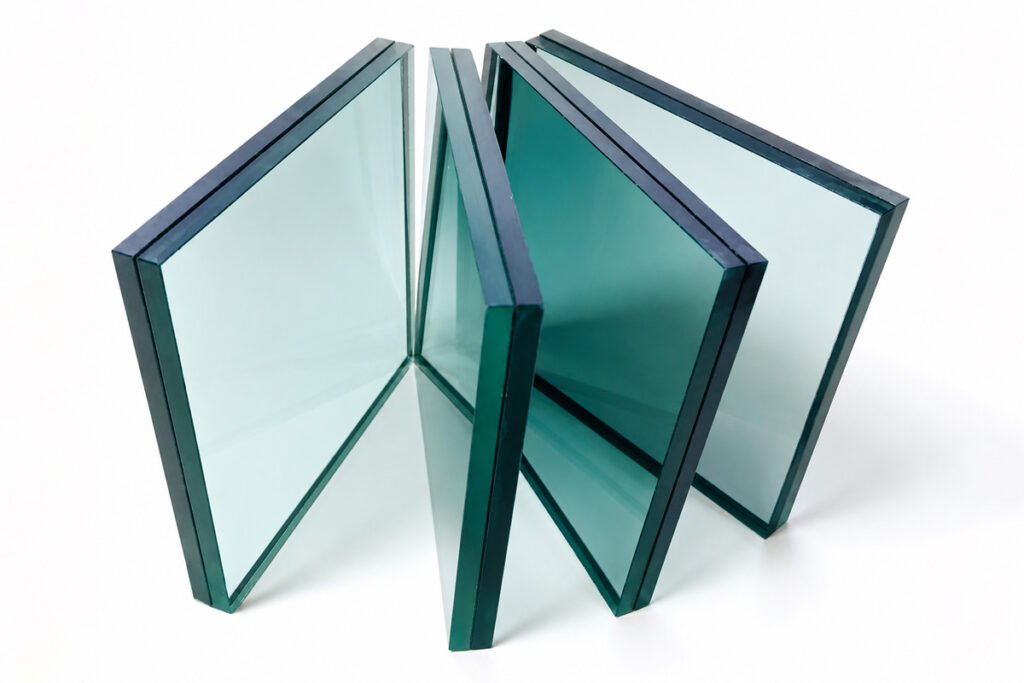
Tempering increases the strength of each glass ply and changes its break pattern. Lamination bonds the plies so fragments are retained after breakage. The finished panel must be specified by the full glass build-up, support and required safety evidence.
| Glass ply | 4-19 mm, equal or mixed thickness |
|---|---|
| Interlayer | PVB 0.38-2.28 mm or ionoplast 0.89 / 1.52 / 2.28 mm |
| Construction | Two-ply, three-ply and multi-ply |
| Glass options | Clear, low-iron, tinted, ceramic printed and compatible coated glass |
| Geometry | Flat, curved, triangles, trapezoids and drawing-defined profiles |
| Processing | Holes, countersinks, notches, cut-outs, polished or beveled edges |
| Size class | Up to approx. 2500 x 6000 mm; construction and equipment dependent |
| Inspection | Ply alignment, holes, bow, roller wave, stress, bond and visual quality |
The Order of Operations Cannot Be Reversed
The route protects finished geometry and prevents attempts to machine a tempered pane.
Why Holes Must Be Finished Before Tempering
Tempering locks compressive stress into the glass surface and tensile stress into the center. Drilling or cutting afterward disrupts that balance and causes the pane to fracture. Hole diameter, edge distance, countersink, hardware clearance and ply-to-ply alignment must therefore be frozen before the tempering release.
Check Nominal Thickness and Ply Symmetry
Use this planning tool to express a two-ply construction clearly. It does not select the build-up for wind, barrier, overhead or point-fixed loads.
- Nominal total
- 13.52 mm
- Ply relationship
- Symmetrical
- Fabrication route
- Complete before tempering
Two Accurate Panes Can Still Make a Poor Assembly
Point-fixed and exposed-edge laminates require the two heat-treated plies to share common datums. Hole offset can create hardware interference; edge step can become visually obvious and alter bearing conditions.
- Hole diameter
- Per ply and finished assembly
- Center position
- Referenced to common datum edges
- Ply offset
- Controlled after lamination
- Edge step
- Visible and functional requirement
Select the Interlayer from the Service Condition
The interlayer name does not replace the glazing design. State grade, caliper, color and every glass ply.
Control Both the Individual Plies and Final Laminate
Inspection is staged so a hole, edge or bow problem is found before it is permanently laminated.
Configuration Follows the Load Case
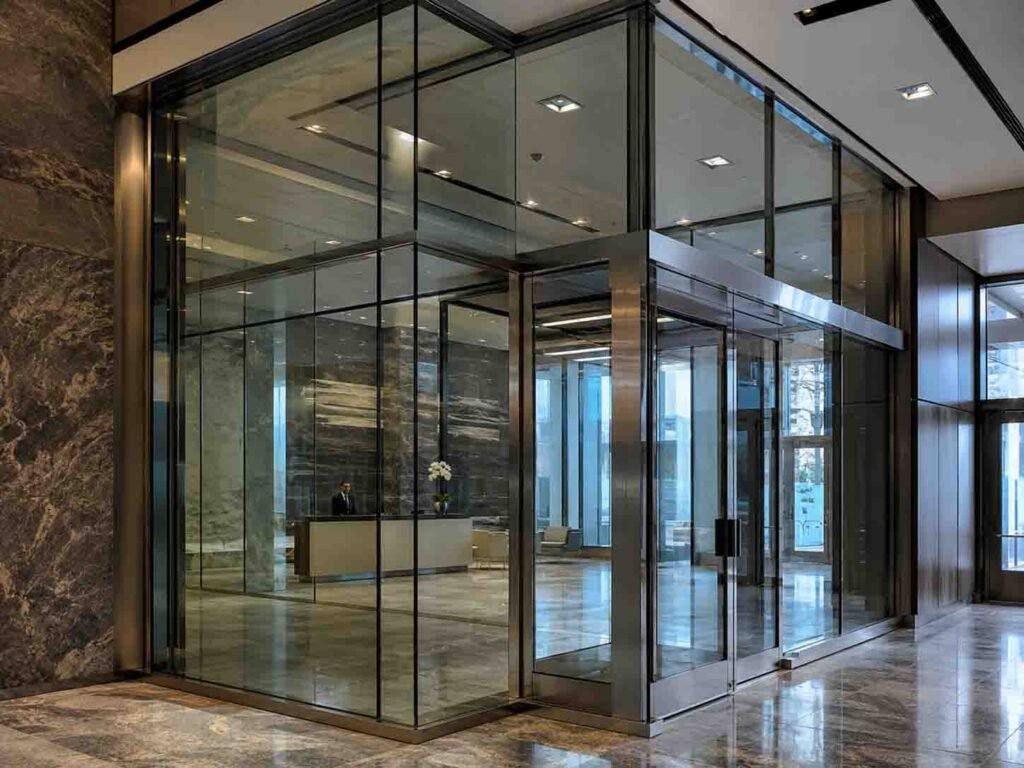
Common thicknesses are useful for quoting, but no nominal thickness is universally suitable for an application.
| Application | Starting Build-Up | Critical Review |
|---|---|---|
| Door / partition | Two-ply tempered PVB laminate | Impact classification, fittings and edge |
| Balustrade | Tempered PVB or ionoplast | Line load, base support and residual barrier |
| Canopy / skylight | Heat-treated laminated glass | Overhead retention, snow / wind and drainage |
| Point-fixed facade | Tempered ionoplast laminate | Hole bearing, local stress and ply alignment |
| Floor / stair | Engineered multi-ply laminate | Redundancy, wear surface and post-breakage access |
Tempered Laminated Glass Questions
Answers focused on process, breakage and specifying.
How is tempered laminated glass made?
Each glass ply is cut, edge-finished, drilled, printed where required and tempered. The matched plies are then washed, assembled with PVB or ionoplast, de-aired and autoclaved.
Can holes be drilled after tempering?
No. Cutting, drilling, notching and edge processing after tempering will normally break the pane.
What happens when tempered laminated glass breaks?
A tempered ply breaks into small fragments that remain bonded to the interlayer. Residual capacity still depends on the surviving plies, interlayer, support, temperature and load.
Can the glass be heat-soak tested?
Heat-soak testing can be specified for compatible tempered panes before lamination. State the required standard and documentation.
Is tempered laminated glass bulletproof or hurricane-proof?
Not by name alone. Those claims require a specific tested assembly, threat level, dimensions and framing system.
What is needed for a quotation?
Send the complete ply and interlayer build-up, heat treatment, drawing, support, holes, edge, printing or coating, quantity and required test evidence.
Freeze Every Feature Before Heat Treatment
Issue one controlled drawing that defines both plies and their alignment. We will review the manufacturing sequence and measurable release criteria.
- Glass thickness and type per ply
- Interlayer grade and caliper
- Finished outline and quantity
- Hole, countersink and notch datums
- Edge finish and permitted step
- Printing / coating side
- Standards and inspection documents
We're Here To Help
Send the build-up, final drawing, support condition, quantity and test requirements. We will review fabrication before quotation.
Saving your time and cost is our common pursuit.
Tell us the material, size, thickness, tolerance, quantity, application, and any holes, slots, edges, coating, printing, or polishing requirements. We can manufacture custom glass components from your drawing, CAD file, sketch, or sample.
- Address
- Yunpu Industrial Zone, Nangang, Huangpu District, Guangzhou
- Call Us
- +86 19860070065
- Email Address
- info@specialglass.net
- +86 19860070065
- +86 19860070065