
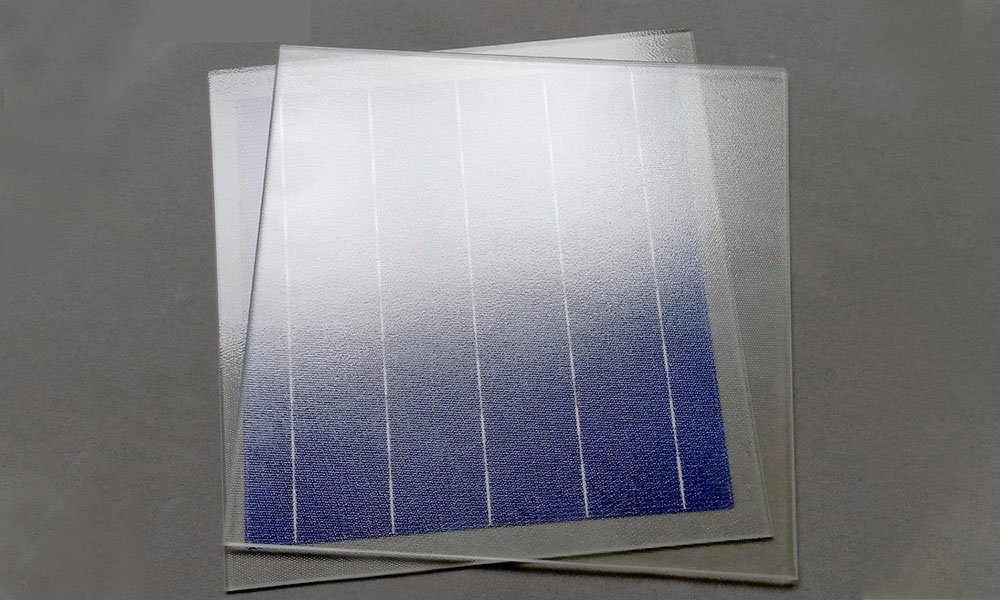
Directional Texture
Prismatic / Matt Solar Glass
A defined prism texture redirects incident light while the opposite matt face provides controlled diffusion. Common for photovoltaic front covers.
Patterned solar glass is formed with a rolled texture rather than a smooth float surface. Low-iron composition limits absorption, while the surface geometry changes reflection, refraction and diffusion before light reaches the solar cells.
The pattern direction, exposed face, AR-coated face and module-side orientation should all be marked on the drawing. They remain traceable through cutting, coating, tempering and packing.
| Glass type | Low-iron rolled / textured soda-lime glass |
|---|---|
| Thickness | 2.0 / 2.5 / 3.2 / 4.0 mm |
| Thickness tolerance | Typical ±0.2 mm; tighter control by specification |
| Surface | Prismatic / matt / fine diffuse / matt-matt |
| Iron content reference | ≤120 ppm for the specified low-iron grade |
| Uncoated transmission | Typical ≥91.5% for common 3.2 mm configurations |
| AR-coated option | Typical ≥94% on selected configurations |
| Heat treatment | Annealed / heat-strengthened / fully tempered |
| Finished processing | Cutting, edging, holes, corners and ceramic printing |
| Orientation control | Pattern side, smooth side, coating side and print side marked |
Unless stated otherwise, numerical values are typical industry references. Final capability and acceptance limits are confirmed against the ordered construction, test method and approved specification.
Surface choices are based on real optical and module-production differences.
A defined prism texture redirects incident light while the opposite matt face provides controlled diffusion. Common for photovoltaic front covers.
A finer texture spreads incident light with less directional surface appearance for PV modules and solar thermal collectors.
Textured faces create a more uniform diffuse appearance for selected module, thermal and architectural solar configurations.
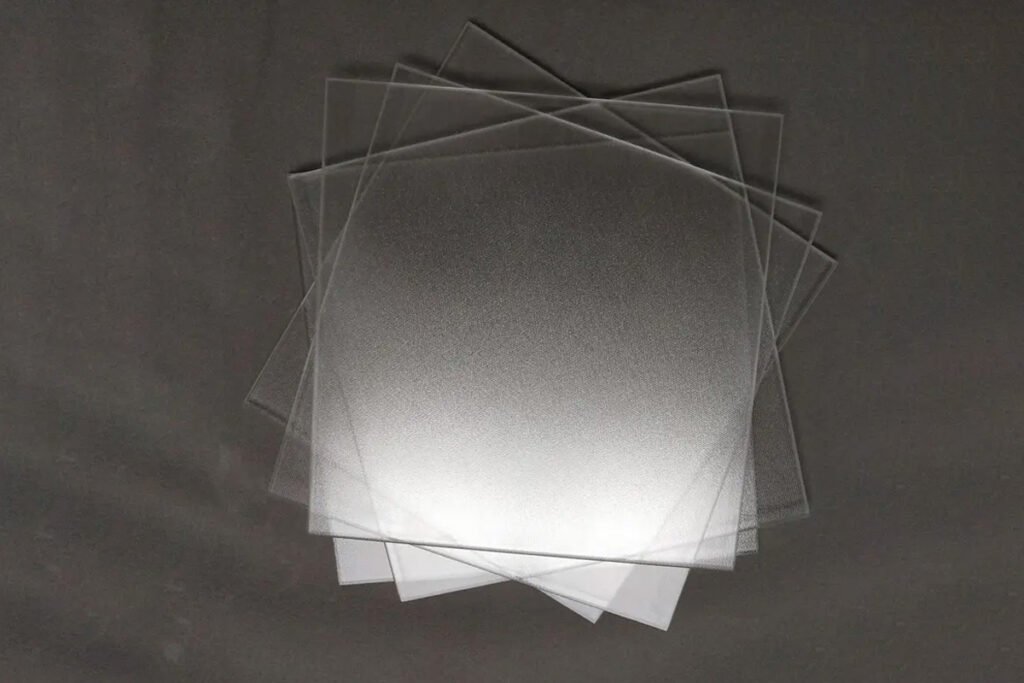
A compatible anti-reflective treatment reduces air/glass interface losses while the rolled pattern continues to manage light direction.
The selector explains how each surface changes the optical behavior. Final samples should be tested in the intended module stack.
Use where a defined rolled pattern is required to redirect incident light over changing angles.
Use where controlled scattering and a softer surface appearance are both important.
Use for selected applications requiring diffuse appearance on both surfaces.
Use where the pattern and coating must work together to reduce front-surface loss.
Mechanical features are completed before tempering. The drawing should identify the functional face and every dimension that controls assembly.
Holes, notches and edge work cannot be added after thermal tempering.
The rolled surface changes the direction and distribution of light. An AR coating reduces reflection at the air/glass boundary. One does not replace the other, so both the base pattern and coating state must be identified when approving optical performance.
Processing protects the optical texture and keeps the designated face identifiable through production.
Produce the approved module outline and diagonal control.
Seam or grind edges; complete holes, notches and corners.
Apply compatible ceramic printing or AR treatment to the defined face.
Heat strengthen or fully temper after all mechanical work.
Inspect, identify surface orientation and protect for lamination.
Inspection limits and reporting level follow the drawing, purchase specification and approved sample.
Thickness and surface should be chosen together with module weight, cell technology, lamination route and exposure conditions.
| Application | Typical Configuration | Design Priority |
|---|---|---|
| Crystalline Silicon PV | 3.2 mm prismatic/matt + optional AR + tempering | High-transmission front cover |
| Glass-Glass PV | 2.0-2.5 mm patterned front glass | Lower module weight |
| Bifacial Module | Thin patterned front glass with transparent rear structure | Front light entry and weight |
| Solar Thermal | 3.2-4.0 mm patterned glass + optional AR | Transmission to absorber |
| Diffuse Solar Glazing | Matt or fine diffuse tempered glass | Controlled light distribution |
These decisions affect optics, tooling, processing and module assembly.
It is normally rolled from low-iron soda-lime glass. The lower iron content reduces internal absorption, while the roller forms the controlled surface texture.
Common configurations include 2.0, 2.5, 3.2 and 4.0 mm. Final availability depends on pattern, size, coating and heat treatment.
Prismatic/matt, fine diffuse and matt/matt surfaces are available configurations. A physical sample should be approved for appearance and optical behavior.
Common 3.2 mm uncoated configurations use a typical reference of 91.5% or higher; compatible AR-coated options may use 94% or higher. The final value depends on the full specification and test method.
Yes, where the selected texture and coating process are compatible. State the exposed face, target transmission and inspection method.
Yes. Cutting, edge processing, holes, printing and compatible coating steps are completed before final thermal processing.
Yes. Mark direction and surface orientation on the drawing so it remains controlled through fabrication and packing.
Typical checks include dimensions, diagonal, surface texture, edge and hole quality, transmission, coating appearance, flatness and heat-treatment requirements.
For patterned solar glass, the drawing and face orientation are as important as the nominal thickness.
Share the application, drawing, performance target and quantity. We will review the glass construction and processing route before quotation.
Tell us the material, size, thickness, tolerance, quantity, application, and any holes, slots, edges, coating, printing, or polishing requirements. We can manufacture custom glass components from your drawing, CAD file, sketch, or sample.