
Industrial Plates & Windows
Flat panels with a defined profile, processed edges and mounting features for non-specialty equipment applications.
Soda-lime glass is widely available as flat float sheet and supports established industrial fabrication processes. Its useful combination is material availability, consistent flat form and compatibility with downstream manufacturing.
SpecialGlass processes the substrate into finished components rather than supplying one generic sheet for every application. Part geometry, printed areas, strengthening state and final surface condition define the delivered product.
| Parameter | Supply Range | Available Options |
|---|---|---|
| Base material | Standard clear soda-lime float | Low-iron composition available separately |
| Thickness | Standard float-sheet grades | Thin cover substrates by grade and process |
| Product forms | Flat plates, windows, panels and discs | Profiles with holes, slots and cut-outs |
| Strengthening state | Annealed or thermally processed | Chemical strengthening on suitable grades |
| Edge finish | Seamed, ground or polished | Chamfers, radii and corner finishing |
| Added functionality | Screen printing and lamination | Compatible AG, AR or AF surface treatments |
Strengthening and finishing are specified for the actual thickness and part geometry. No universal pressure or operating-temperature rating is assigned to float sheet.
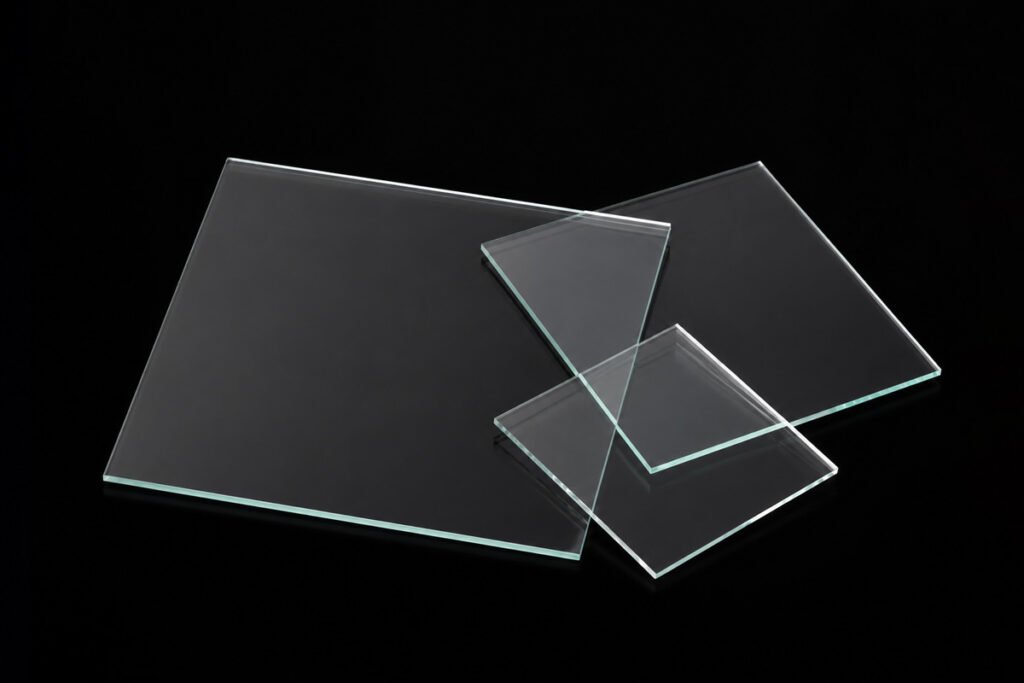
Component-form reference: plates and windows. Appearance alone does not identify the glass composition.
Flat panels with a defined profile, processed edges and mounting features for non-specialty equipment applications.
Opaque backgrounds, symbols, transparent viewing areas and controlled backlit windows.
Processed sheets strengthened after the required cutting and machining operations.
Multi-layer constructions specified by glass thickness, interlayer and finished assembly requirements.
| Operation | Process Position | Finished Feature |
|---|---|---|
| Cutting & CNC | Annealed sheet before strengthening | Outline, holes, slots and cut-outs |
| Edge processing | Before thermal strengthening | Ground/polished edges, chamfers and corner radii |
| Ceramic printing | Before its qualified firing/heat-treatment cycle | Artwork, opaque areas and viewing windows |
| Thermal strengthening | After the final mechanical features | Selected thickness and geometry |
| Functional treatment | Sequence depends on coating technology | Specified face, optical/cosmetic zones |
| Lamination | Prepared glass plies before final bonding | Ply alignment, interlayer and edge construction |
Thermal tempering creates a balanced stress distribution between the glass surfaces and core. Drilling, cutting or deep edge machining after tempering can disturb that balance and cause sudden breakage.
Holes, slots, profiles and edge finishes are therefore completed before heat treatment. Their position and shape also affect heating uniformity and stress concentration. The final drawing must include those features before the part enters the strengthening stage.
Low-iron float reduces the green bias visible in light-colored printing, exposed edges and transparent assemblies.
Borosilicate or other technical grades can be more appropriate for applications involving significant thermal gradients.
Aluminosilicate grades offer a defined ion-exchange route for thin display and touch-cover components.
Material, processing and finished-component details.
Suitable grades can be ion-exchanged, but the achievable stress profile differs from purpose-designed aluminosilicate grades. The substrate, thickness and specified strengthening result are reviewed together.
No. Holes, cut-outs and major edge machining are completed before thermal tempering. Post-temper machining can trigger breakage.
Float describes a forming process. Standard clear float is normally soda-lime glass, while other compositions may also be supplied as flat sheet. The material grade identifies the composition.
It can be used, but its green bias may influence white or light-colored artwork. Low-iron glass is an alternative where color neutrality is important.
Yes. The supplied part can include the specified outline, edge treatment, holes, printing, strengthening and compatible surface treatment.
Include: part drawing, thickness, quantity, edge finish, holes or openings, printing and required strengthening state.
We review the machining sequence, finished surfaces and inspection requirements before production.
Tell us the material, size, thickness, tolerance, quantity, application, and any holes, slots, edges, coating, printing, or polishing requirements. We can manufacture custom glass components from your drawing, CAD file, sketch, or sample.