Your Reliable Partner For Custom Special Glass In China
Specification Logic

Four Dimensions Define the Finished Glass Rod

A glass rod is solid throughout its cross-section. It is ordered by material, outside diameter, finished length and end condition. Surface finish and straightness are added where the rod must fit, rotate, transmit light or serve as a machining blank.

Borosilicate 3.3 is the practical route for laboratory and general technical service. Quartz or fused silica is selected when expansion, temperature or wavelength requirements exceed the useful range of borosilicate.

Rod is not tube. A rod has no bore. A tube must instead be specified by outside diameter, inside diameter and wall thickness.
MaterialBorosilicate 3.3Quartz / fused silica option
Diameter3-40 mmCustom diameter reviewed
LengthUp to approx. 1500 mmFinished cut length available
Cross-SectionRoundCustom solid profile by drawing
EndsCut / ground / polishedChamfered or rounded option
Supply StageStock to finished partStop processing where your route begins
Material Routes

Choose Rod Material Before Diameter and Finish

The same geometry can behave very differently in thermal service. Start from the operating environment, then set the finished dimensions.

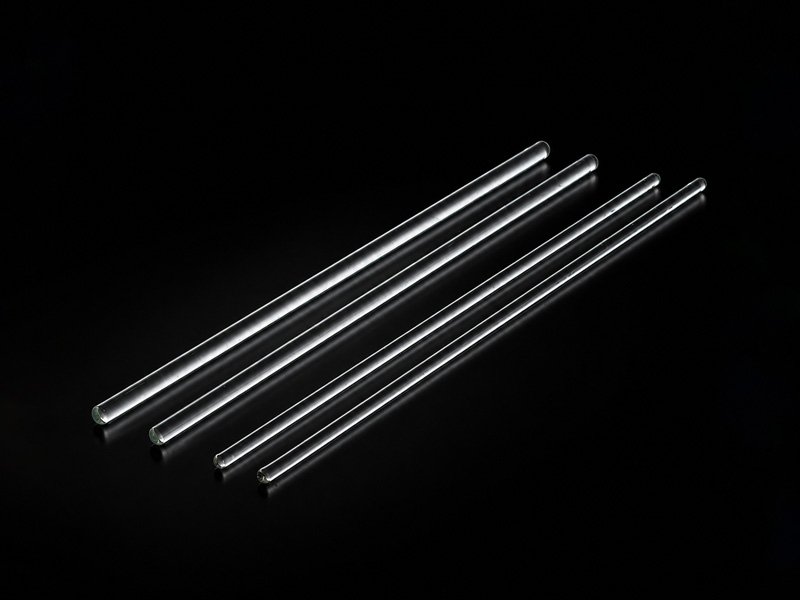
Solid borosilicate glass rods in multiple diameters
General Technical Route

Borosilicate 3.3 Glass Rod

Low expansion, good chemical resistance and practical glassworking make borosilicate the normal starting point for laboratory rods, technical equipment and fabrication stock.

CTE
Approx. 3.3 x 10⁻⁶/K
Density
Approx. 2.23 g/cm3
Softening Point
Approx. 825°C
Quartz and fused silica glass rod stock
Higher Thermal Route

Quartz / Fused Silica Rod

Very low expansion and a much higher softening point support high-temperature, thermally cycled and wavelength-sensitive components where the exact fused-silica grade is also specified.

CTE
Approx. 5.5 x 10⁻⁷/K
Density
Approx. 2.20 g/cm3
Softening Point
Approx. 1780°C

Material values are typical references. Confirm grade, temperature definition, atmosphere and test method before using them as design limits.

Diameter & Length Planner

Estimate Cross-Section and Order Mass

Use the calculator to check the physical scale of a solid round-rod order. It is a planning aid for material and packing, not a quotation or dimensional guarantee.

Nominal cylindrical volume only. Grinding allowance, rounded ends, dimensional variation and packing are excluded.
D10 x L500
Cross-Section78.54 mm2
Mass / Piece87.6 g
Estimated Order Mass8.76 kg
End Geometry Selector

Define the End by Function, Not Appearance

Cut stock, handled laboratory rods and assembly-ready parts need different end conditions. Select a finish to review its manufacturing purpose.

End AEnd B
Downstream Stock

As-Cut Ends

Use when the customer will perform additional grinding, fire polishing, forming or machining. Edge condition and handling protection still need agreement.

Lowest finishing input; not intended as a handled finished end.
01

Why Finished Length Is Measured After End Processing

Grinding, polishing, chamfering and rounding remove material from the rod ends. If length is controlled on the raw cut blank, the final part can finish short or vary from piece to piece. Drawings should define the completed end geometry and measure length on the finished part.

Supply Stage

Stop Processing Where Your Production Begins

Not every order needs polished surfaces or CNC finishing. Select the earliest stage that is usable in your process to avoid unnecessary cost and handling.

Glass rod stock and finished rod components
  1. 01
    Full-Length Stock

    As-formed and annealed rod for glassworking or customer-controlled fabrication.

  2. 02
    Cut-to-Length Blank

    Repeated lengths prepared for downstream processing, assembly or inventory.

  3. 03
    Finished Rod

    Ground, polished, chamfered or rounded ends; optional cylindrical surface finishing.

  4. 04
    Machined Cylindrical Part

    Pins, spacers, stepped sections and custom components produced from rod stock.

CNC machined cylindrical glass components made from rod stock
Secondary Processing

From Solid Rod to Finished Cylindrical Parts

Rod stock is a practical blank when the finished component is naturally cylindrical. The process can combine cutting, cylindrical grinding, diameter finishing, end grinding, polishing, chamfering and compatible CNC operations.

Short PinsPrecision SpacersGround SectionsPolished BlanksStepped PartsCustom Profiles

Machining feasibility depends on diameter, feature depth, transition radii, material grade and quantity. Sharp internal transitions and very thin sections should be reviewed before tolerances are fixed.

Review CNC glass processing
Measurement Strategy

Inspect Along the Rod, Not at One Point

One diameter reading cannot reveal taper, local variation or bow. Finished rods are checked as a length-dependent component.

Datum surface
OD-1OD-2OD-3OD-4OD-5
Straightness / bow over inspected length
Outside DiameterMeasure at agreed positions and axes
Finished LengthCheck after both ends are completed
StraightnessReview bow over the specified span
End FaceFlatness, polish and chip condition
SurfaceScratches, inclusions and grinding damage
MaterialBorosilicate or fused-silica grade control
Application Matrix

Match the Rod Configuration to Its Next Operation

The most useful product form depends on whether the rod will be handled, installed, heated, optically finished or processed again.

Glass rods for laboratory and technical applications
ApplicationStarting ConfigurationKey Control
Laboratory stirringBorosilicate, cut length, rounded or polished endsSafe handling and chemical durability
Glassworking stockBorosilicate full length or cut blankMaterial compatibility and annealing
Technical pins / spacersGround diameter, finished endsFit, length and straightness
High-temperature equipmentQuartz grade, custom diameter and lengthThermal duty and atmosphere
Optical / instrument blankSelected fused silica, ground or polishedGrade, wavelength and surface quality
Machined componentRod blank sized for material allowanceFeature geometry and grinding route
Quick Material Decision

Borosilicate or Quartz Glass Rod?

The diameter does not decide the material. Use the environment, thermal expansion and optical range.

RequirementBorosilicate 3.3Quartz / Fused Silica
General laboratory usePreferredAvailable
Thermal expansionLowVery low
High-temperature serviceGoodHigher capability
UV optical serviceGrade-limitedSelect suitable fused-silica grade
Processing economyMore practicalHigher material / processing cost
Technical componentsYesYes
Procurement FAQ

Glass Rod Questions

Answers focused on material, geometry, finishing and inspection.

What is a glass rod?

A glass rod is a solid glass profile without an internal bore. It can be supplied as long stock, a cut blank or a finished cylindrical component.

What is the difference between a glass rod and a glass tube?

A rod is solid and specified by outside diameter. A tube has a bore and must be specified by outside diameter, inside diameter or wall thickness.

What materials are available?

The main routes are borosilicate 3.3 and quartz or fused silica. The exact grade is confirmed from thermal, chemical and optical requirements.

What diameters and lengths can be supplied?

A practical diameter range is approximately 3-40 mm. Full lengths up to about 1500 mm and custom cut lengths can be reviewed by material and quantity.

Can both rod ends be polished?

Yes. Ends can be supplied as-cut, ground, polished, chamfered or rounded. The drawing should state whether both ends use the same finish.

Can the outside cylindrical surface be ground or polished?

Yes. Cylindrical grinding can improve diameter control, followed by surface polishing where a smoother transparent finish is required.

When should quartz rod replace borosilicate?

Use quartz when very low expansion, substantially higher temperature capability or a fused-silica optical range is required. Confirm the exact grade and service conditions.

Can rod stock be machined into stepped parts?

Yes, subject to diameter, step depth, transition radius, final wall or section size and material. Send a drawing for route and tolerance review.

How is straightness specified?

State the allowable bow and the inspected span. Long rods should not be accepted from one diameter measurement or a visual check alone.

What information is needed for quotation?

Send material or grade, diameter, finished length, quantity, straightness, outside surface, both end conditions, dimensional tolerances, inspection level and packing requirement.

RFQ Preparation

Send a Rod Drawing or Dimensional List

For simple stock, a dimensional list is enough. Finished and machined parts should use a drawing that defines datums, end geometry and measurement positions.

Include these details:
  • Borosilicate or fused-silica grade
  • Outside diameter and tolerance
  • Finished length and quantity
  • Straightness over stated span
  • Outside surface condition
  • End A and End B geometry
  • Inspection report and packing needs
Request a Quote
Contact Our Glass Engineers

We're Here To Help

Tell us the material, diameter, finished length, end condition, tolerance and quantity. We will review the rod route before quotation.

Saving your time and cost is our common pursuit.

Tell us the material, size, thickness, tolerance, quantity, application, and any holes, slots, edges, coating, printing, or polishing requirements. We can manufacture custom glass components from your drawing, CAD file, sketch, or sample.

Address
Yunpu Industrial Zone, Nangang, Huangpu District, Guangzhou
Wechat
+86 19860070065